

Tracks of the Week: Two Late ‘80s Philly Beats That Still Bang
Philadelphia was on fire in ‘87 and ‘88. Meet two of the chief arsonists.
Jive Records. 1988. The album is Smoke Some Kill. The artist is Schoolly D. The track is “This is It (Ain’t Gonna Rain).”
The heavy drum machine and loose, funky soundscape are so pristine, Schoolly doesn’t even drop a single line until the 1:08 mark:
Schoolly D produced this track and he trusted his groove utterly. He let it breathe. No rush on that first verse. Good layering here anchored by that workmanlike drum, the accents wafting in like opium smoke. Why not show off the build?
More BGS listeners probably recognize him as the voice from the theme of Aqua Teen Hunger Force than a nasty Golden Era don. But from the ‘80s to Adult Swim to even now, he hasn’t tried to switch up his style one little bit. He knows who he is and what he’s here to do on the mic.
Fun fact: Schoolly is one of the godfathers of gangster rap. Ice T often cites Schoolly’s 1985 track, “P.S.K. What Does it Mean?” as Ice T’s inspiration for his foundational West Coast gangsta classic single, "6 'N The Morning.” (Say it with me: “Six in the mornin’, cops at my door/Fresh Adidas squeak across the bathroom floor”)
I’m not trying to be one of those weepy “hip hop hasn’t been shit since Tupac and Biggie” dudes on YouTube comment sections, but if there’s one way that Golden Era albums were distinctively superior, it was setting aside a whole track on an LP so a DJ could have a workout.
The man on the wheels of steel here is Tat Money, who DJed for Steady B. I love this microphase of the genre. The drum machine patterns are harder, smoother, and more organic, and the baseline for turntable skills is getting higher by the week. Tat Money is patient here. The mix and the drum machine are the key features, but his final display is still a ton of fun to hear.
I also love that last little squeaky scratch and the way all the cuts sit on top of that burly beat. This is the era — and the city — that birthed the Transformer scratch, an innovation from DJ Cash Money that spread like wildfire, tape to tape, hand to hand, show to show.
Other Philly stuff you should be checking out from this era is Rock the House, DJ Jazzy Jeff and the Fresh Prince’s first LP. Jazzy commits the Transformer technique to a record on that one.
Also see: Where’s the Party At? by DJ Cash Money and Marvelous Marv. Cash goes on to win the DMC turntable championships in the UK not long after that.
Check out 50 Golden Era Hip Hop Deep Cuts You Must Experience
Pavlov’s House Replays: I Aimed for Glory and Found a Nastier Game
I return to Pavlov’s House 20 episodes after my first review. And find my basic game doesn’t match my new dreams of mastery.
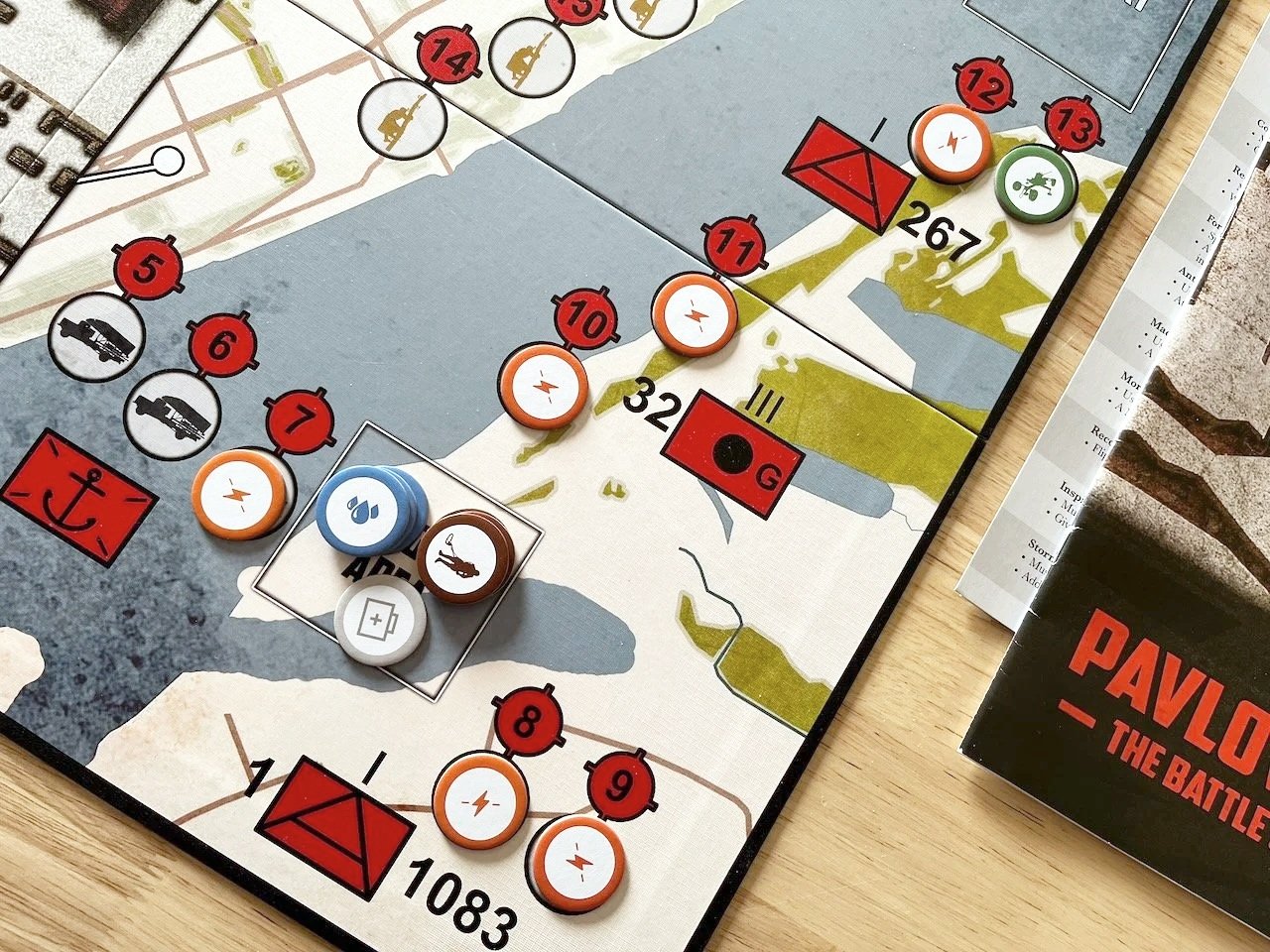
Pavlov’s House: Stukas punishing the Russians’ operational and command areas early, as they do. Orange tokens represent hits on transport lanes, artillery and anti-aircraft sites.
So it’s the end of a game of Pavlov’s House and I’ve decided to execute every soldier and officer under my command.
The execution takes place in the form of flicking each soldier counter off the board as hard as I can.
“Somebody FLICK has to FLICK make FLICK a fucking shot FLICK from time to time FLICK.”
It takes me a while to find all the glossy counters. I have to dig Potanski, one of my artillery spotters, out of a vent on the floor.
I figure that’s enough Pavlov’s House for now. I’d had it out on the table for more than a week, running at least a game a day, sometimes two.
Pavlov’s House from Dan Verssen Games is one of my current Big Four: If you took all my other games away and said I could only play Pavlov’s House, Thunderbolt Apache Leader, Space Hulk: Death Angel and Final Girl for the rest of the year, I’d be OK. Well, I’d miss Cartographers because that’s my current light and clever palate cleanser.
I learned Pavlov’s House 20 episodes ago and gave it a glowing review. Still would today, even though it treated me cheap at the end of the last series. I still love it, temper tantrum aside.
Quick recap: Pavlov’s House — designed by David Thompson — lets you take command of a group of Soviet soldiers during the winter of ’42. It’s Stalingrad, WW2’s most infamous sub-zero meat grinder.
The Russian brass wants Sgt. Pavlov and his humble starting detachment of three soldiers to defend and hold an apartment block that sits on 9 January Square. The German 6th Army very much wants you not to defend and hold that apartment block on 9 January Square. They are willing to throw a lot of Stukas, bodies, tanks, and shells at the problem.
Your job is to build up the right mix of soldiers and weapons in the house. You command and maneuver them, trying to keep them supplied with new material and reinforcements as the German ground assault builds in intensity. German infantry and armor spawn on three sides of the house and start filling up assault lanes. If they overflow a lane, the house has been breached and you’ve failed Mother Russia.
No front page in Pravda for you.
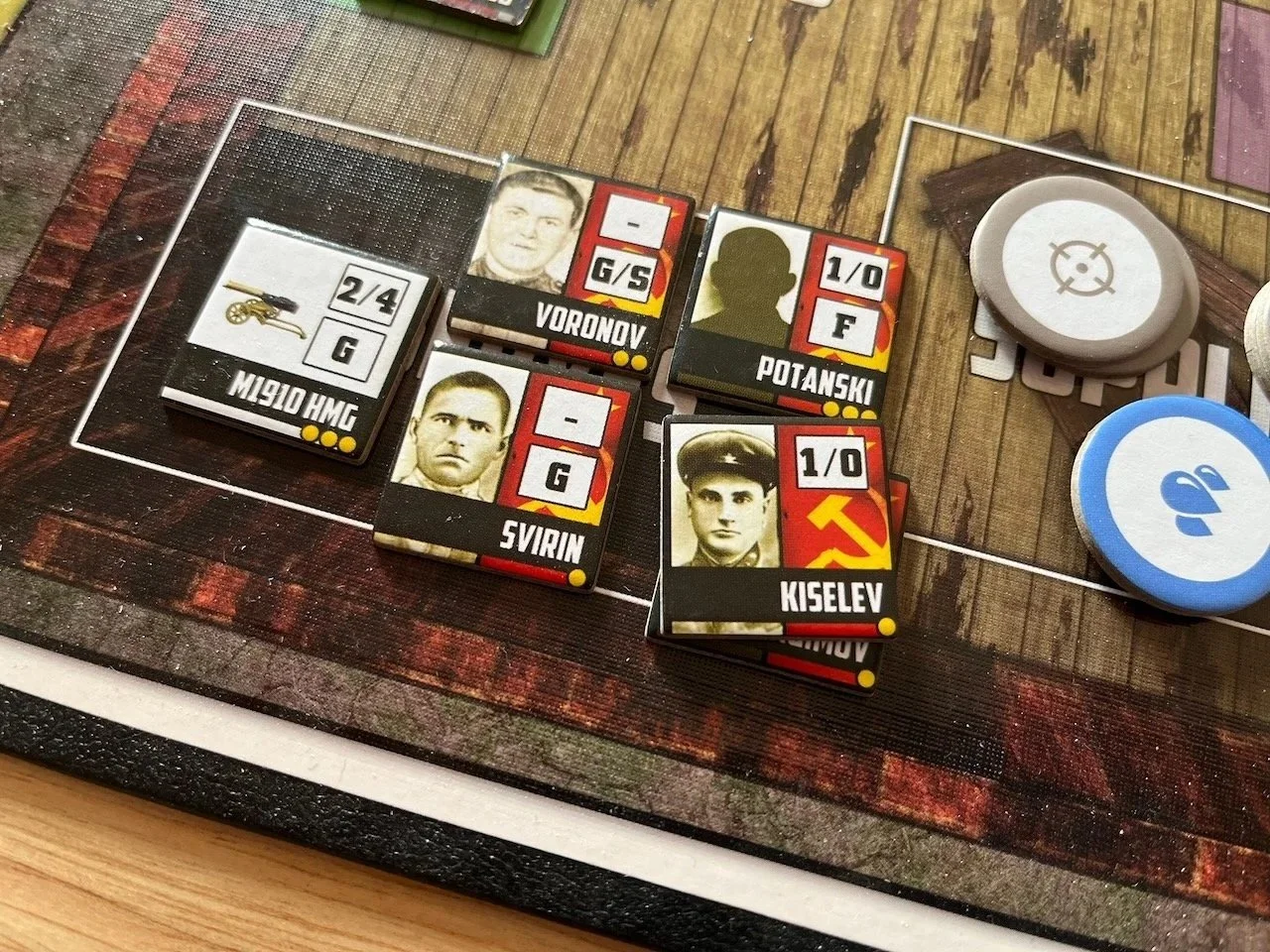
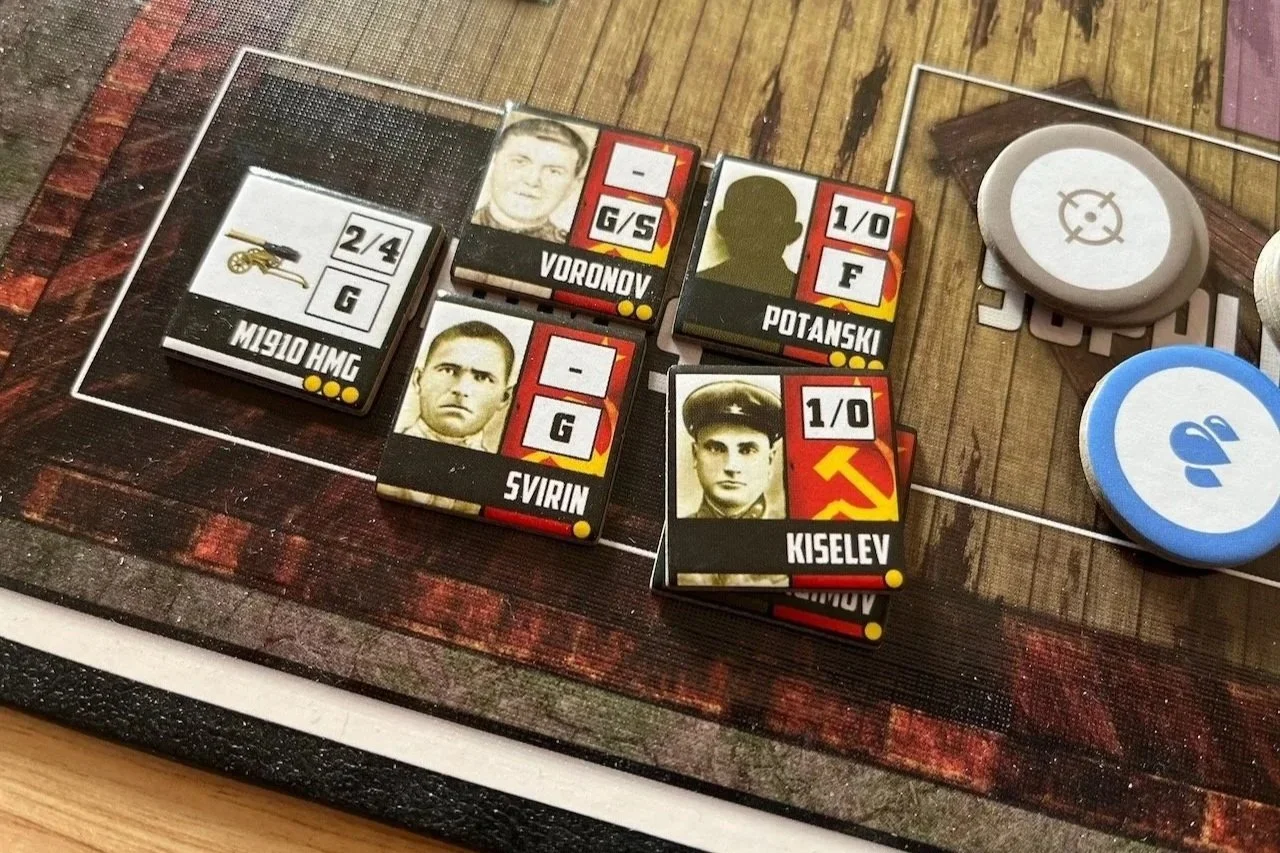
A good mix of reinforcements arrives in Reserves: MG specialists Voronov and Svirin with requisite hardware; Potanski, an artillery spotter; and troopers Kiselev and Agimov. Look at the intensity on those faces. None of them will do anything.
Why did this land in my Top 4 and stay there?
The main reason: Tactical personality with an operational element, all without being too heavy.
On the right side of the board, you’re looking at the high view of the major command elements around the Volga. At the top of a turn, you have to think like Russian brass and make tough decisions about how you can help the boys stuck in the House, which is actually a three-story apartment block.
Designer David Thompson made this engaging and detailed without getting cumbersome: The first interesting part is using a limited selection of action cards to decide whether you want to send reinforcements, supplies, improve comms, issue special orders, or clean up and ready key anti-aircraft or artillery sites.
The second interesting part is getting the shit blown out of you by Stukas.
Sure, you can get a lot of stuff done if you skimp on air cover, but a turn doesn’t go by when you’ve decided to push extra supplies over the Volga, looking at the frozen November sky for incoming dots and wondering, “Did I just fuck up?” If you can’t stop enough Stukas, all your possibilities constrict. Misfortune cascades down to the House.
The perspective tightens in the middle of the board, showing an aerial of the building you occupy and the six approach tracks where German infantry and armor will spawn and start to press in. You can also expect snipers, mortar attacks, and, if you look out the right side of the tour bus, artillery.
On the left board we zoom into the House, where your men duck, move, starve, yell or go fetal when a German mortar team dials them in. Their counters have actual mug shots of the dudes who fought there: officers, troopers, sharpshooters, support weapon specialists, and artillery spotters.
Again, detail and pace blend wonderfully here. A simple movement and action point allowance governs move-ready-shoot, with enough granularity around leadership and individual unit abilities to keep your interest.
Moving right to left across the three sections of board has plenty of exciting wrinkles — like the different strategies you can try with reinforcement — while sustaining a quick-paced story of outnumbered men setting their jaws against oblivion in a ruined city.
I blew the dust off my classic template for playing this and did pretty well. My conservative strategy of lavishing air cover on the right side of the board and keeping sapper teams and food coming into the house meant I could hang on for Draws or Minor Victories most of the time. I even earned the lowest-tier Major Victory once and got awarded the Order of Suvorov.
But I started craving the big shit: Order of the Red Banner. Order of Victory. The 50+ point Epic Victory. That’s gotta be good for a tin of caviar or a weekend at the dacha.
The game, to its credit, gives you ways to go balls-out and not only defend the House, but earn more glory with suicidal raids or interrupting your usual flow by committing turns and supplies to other pots on the crowded Soviet strategic stove.
Each time one of the game’s three supply checks occurs, HQ will give you an assignment outside of the House. If the path is clear, round up a Storm Group, rack up those PPSH-41s and sally out to clear a nearby location in a rude surprise counterattack.
This can get you extra VPs, but the odds say 60% of the guys you send aren’t coming back. Can you afford to lose your one officer? Recruiting for Storm Group readiness without compromising defensive muscle is one of the game’s puzzles. It takes guts, too.
There’s also another variant I started adding late in my series. We know that high command has a lot to think about, and that’s the game logic behind the operational action scarcity around the Volga. But you can add Operational Support cards that put specific historical names on those boiling pots.
If you give up resource tokens from the pool and meet other conditions listed on the card — and you’ve got the opportunity to burn a 62nd Guards HQ action — you can snap up extra VPs.
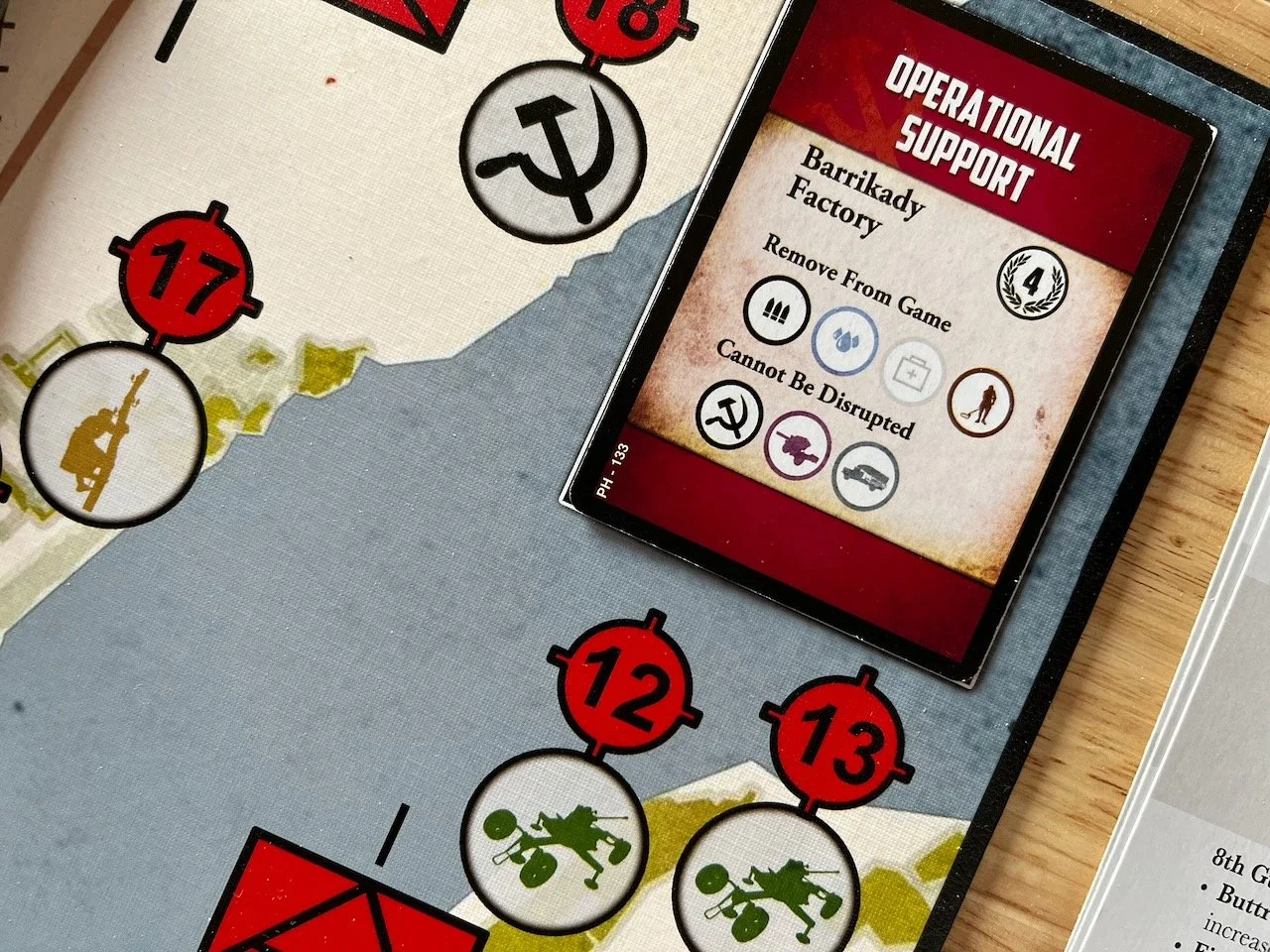
The Operational Support variant lets you wager valuable ops actions on a better score, but you gotta meet the requirements and hope you don’t compromise the imperative to defend the House.
I started doing all this. And I started losing games because I was stumbling into hidden mathematical traps on the board.
And on the day I yeeted all my dudes, I was also snakebit by the dice. The German artillery were striking my fortifications at will. My specialists missed every critical shot they had to make in the late game, when the most infantry and armor appears.
You can plan and play extremely well and still end up hosed, even when you know you positioned well, so that will be something you’ll have to handle better than me if you want to be a big hero. Bouncing dice are going to yank your whole game this way and that. A bad streak will wreck several turns of prudent moves.
Just the same, I intend to keep coming back because now I’ve got a new alloy of curiosity, ambition and hatred in my body. I’m a patient student and I do not forgive.
Playing and writing about this game for two years has given me happy moments outside the victories: I’ll post about it and somebody who got it in 2018 will be reminded to pull it off the shelf.
Or I meet somebody else who doesn’t even know about the Valiant Defense series, which also includes Lanzerath Ridge, Guadalcanal, Soldiers in Postmen’s Uniforms, and Castle Itter.
Get it back out on the table if it’s been a while.
Or go check this series out if you’re looking for a menu of solitaire-forward WW2 games that give you electrifying choices and vivid stories without too much rules overhead.
Take to the air with pre-painted minis and a reimagining the WW2 dogfight game.

Crate Digging: July 2027
The best “Ring of Fire” cover maybe ever, an inviting Discord for tabletop designers, and more. This is what I’m into for July.
6 Things I’m Watching, Playing, Reading or Thinking About
🎵 “Ring of Fire,” Wall of Voodoo
Sitting on the same set where they shot the video for “Mexican Radio,” Wall of Voodoo keeps the stage and covers Johnny Cash’s “Ring of Fire.” A haunting interpretation, with its precise application of synth, percussion, guitar, and lead man Stan Ridgway’s cerebral playfulness. One-hit wonder? Not in my house. 1982’s Call of the West was a masterpiece.
🎲 Nate Tyler’s Family Board Game Vignettes
Hey, remember Lunch Money? How about GolfMania? Dad, copywriter, and Midwestern expat Nate Tyler narrates a four-generation family game table epic. The section where his Dad invents a baseball league manager game they can play together because young Nate had cabin fever got me right between the eyes. Hire this guy if you can.
📕 The Earthsea Trilogy, Ursula K. Le Guin
Le Guin’s original Earthsea trilogy didn’t have the best chance with eighth-grade me; I’d just finished The Lord of the Rings trilogy and Earthsea’s more contemplative approach to the fantasy epic suffered in LotR’s shadow. Now I revisit it in my 50s, grateful for a chance to break the wrestling matches with litfic, sink into a yarn, enjoy the beauty and generosity of Le Guin’s approach. I didn’t realize what Sparrowhawk was trying to teach me the first time.
🎲 Cardboard Commons
Graphic artist, web developer and small game designer/publisher Jason Katzwinkel (The Seahorse and The Hummingbird) runs a supportive and well-tended gathering place where first-time and published designers alike provide support, feedback and bonhomie for every stage of the game design process. As Katz himself says, “Feel free to come have a look, see if you vibe. We'd love to see your games!” Here’s your Discord invite.
🎲 Master of Coin from Postmark Games
Time’s almost up if you want to back the Postmark posse’s latest print-and-play. This time it’s money: Flipping coins has a bearing on which action spaces you can use to build out your own fantasy kingdom. Heads or tails will constrain your infrastructure, research, and military choices. Like everything they do, it looks tight as hell. Postmark’s 52 Realms Adventures was my buddy’s solo gateway drug. True story.
🎲 The Indefatigable Dave Roy’s Favorite of 2026 (So Far)
Dave Roy over at Dude! Take Your Turn continues to rack up an unbelievably diverse diet of play as he cuts grooves in the Canadian con circuit. Out of everything he’s tried this year, I wanted to know which one would he’d replay first IRL. It’s Speakeasy. Why? In his words: “Speakeasy is such an immersive game for theme with intricate (yet simple) mechanics that give you so many choices and yet you always feel like you just need one more action than you have to do what you want to do.”
Have a rare and beautiful recco? Hit me up.
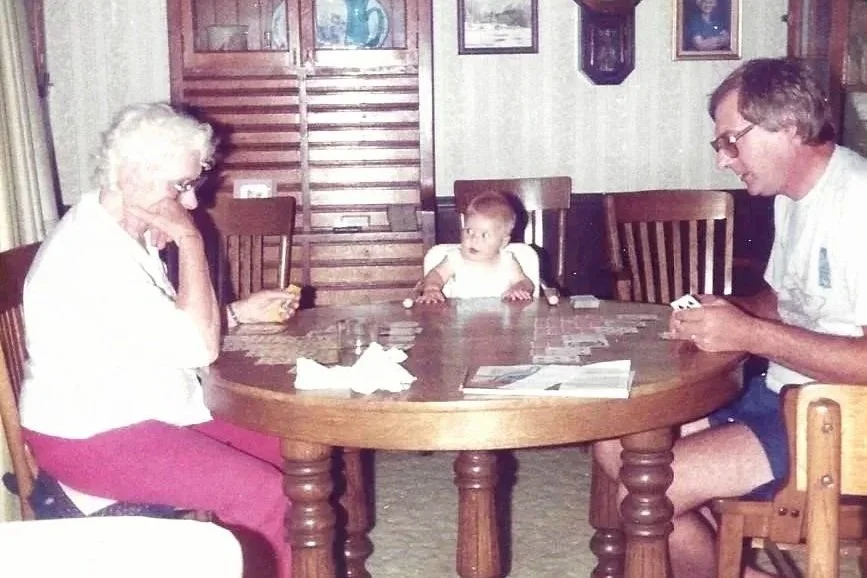
The Laughter Remains: Four Generations of Family Board Game Memories
Nate Tyler paints four generations of family play in vignettes, from Spite and Malice with grandma in Minnesota to his own kids today.
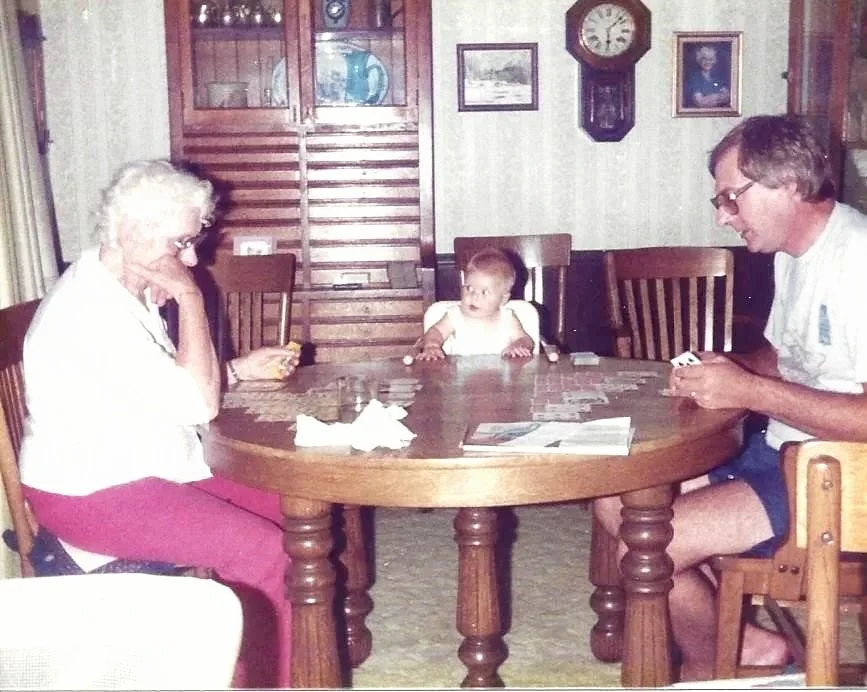
Nate Tyler (center), sits in his parents’ dining room, admiring a deft play by his grandma. That’s his dad on the right, probably getting beat.
The Laughter Remains
By Nate Tyler
The flames shook in the fireplace and we rolled. The game was Golf Mania, a ridiculous—and seriously fun—card and dice game, and between that and the sugar and beers, we had the buzz.
We were sitting around the table in the baseball corner. Beers, sodas, and small plates of Rice Krispie treats and Russian teacakes, brownies and Christmas cookies, lined the edges of the table.
Above us, a floral, stained glass pendant light hung, and pictures of Babe Ruth, Lou Gehrig, Mickey Mantle, Josh Gibson, Reggie Jackson, Harmon Killebrew and so many more lined the walls. Behind us, people walked in and out of the sliding screen door where outside, another fire rippled in the campfire pit to keep the smokers and fresh-air breathers warm in the Minnesota winter night.
At any moment there were six to eight of us around the table—me, my dad, my cousin Paul, his brother Mark and some of his kids, and some other cousins’ kids. I’m the youngest cousin by at least 20 years, so there’s always that weird gap that needs to be explained. “Yeah, I’m the same age as them. Nope, their dad is my actual cousin.”
The hole ended and we dealt new cards. “I’m taking this hole,” my dad said. “I can feel it.”
“Alright,” Paul said. “We all ready? Let’s go!”
In a clump people started throwing cards down, as fast as they could before someone else knocked them out of the hole. I laid down Drunken Golfer and didn’t say anything, just rapped the table with my knuckles. Someone noticed. Arms flew out, avoiding drinks, knocking the table.
“You were last!” we pointed at my dad.
“GoddamnsonofabitchmotherfuckerIalmostspilledmybrandystupidknocking.”
We laughed and the game went on.
Golf Mania is a classic screw-your-neighbor game published by Fantasy Flight Games. It came out in 1997, and it’s made for loud, laughing groups who may be drinking even on holes that don’t call for it. For us it was a perfect chaotic party game.
A game with one random card that makes everyone scramble to knock the table and almost spill all the drinks? Sign me up. Or just one card where you randomly yell “HELP?” Yes please. It’s the absolute right game for people who you want to share a beer with but definitely don’t want to talk politics with.
There are two types of cards: Hole cards, and Game cards. The Hole cards have two numbers on them. The first is the par. If you roll the dice at or under that number (or get there through some Game card play) then you make the green. The second number is the points that the card is worth. You can either play up to 9 or 18 points, as the rules say, or play 9 or 18 holes, as we often did.
The Hole cards have two other symbols: the hazards. There are three types of hazards in Golf Mania: critters, weather, and drinking. Each hole allows two of them, and yellow Game cards with a given symbol can be used during the hole. I’m sure you can guess what type of hole lets you lay down Drunken Golfer. Poodle Love, a critter card, is when an excited poodle runs across the course and latches onto your leg and just won’t leave it alone so you shoot poorly, adding +1 to all of your rolls. Nobody wants a poodle on their leg.
There are other Game cards, including metallic Equipment cards to help you get on the green, or to block your opponents from messing with you. There’s brown Terrain cards that can only be laid down once per hole. There are blue cards that can help you out, blocking someone else’s card or giving you a lower score on a drive or putt. And there’s red Stress cards, where you flip out, break a club on a tree, and if you use two of those cards, you can block any other cards.
Once you get to the green, the lowest roll wins the hole. It sounds a bit ridiculous, and it is. But it was one of our usuals for many years at family get-togethers. Christmas. Easter, summer gatherings, Thanksgiving.
***
For the last 30-odd years of her life, my grandma lived in a small town of a couple hundred people in south central Nebraska by the Kansas border. She had 4 kids, 14 grandkids, and a bunch of great- and great-great grandkids. And they spread out: D.C., New York, Arizona, Oregon, Hawaii.
But all of us within 15 hours driving distance made the trip to her house at least once a year. For our family, that meant 10 hours and usually arriving sometime after midnight. And by the time we woke up, the entire town knew we were there. The elementary students called each of the elderly folks in town every morning to check in on them, and they’d always ask what time we got in.
In a tiny farming town, there were only really three things to do: visit other family, eat, and play table games. But family visits only lasted for a couple hours at a time, and you could snack on baked treats while playing table games.
The only way to properly describe my grandma’s love of games is this: two weeks before she died at the age of 95, she was still hosting her weekly game night (usually Pinocle) with the dozen or two women in town who were over 70. And if we happened to be there on that game night, she never cancelled it.
There were two games I remember playing the most around her square kitchen table under the single light fixture: Mexican Train with a set of 12-numbered dominoes, and Spite and Malice. Apparently, none of the rest of us remember how to play anymore, since it’s been about 25 years, but the rules for Spite and Malice listed online are nowhere near what we played. For one thing, those say to use two or three decks of cards. She had a dedicated set with about 15 decks shuffled up in a wicker basket just for Spite and Malice.
As for Mexican Train, it’s a classic domino game. Start with a double in the middle, draw a bunch of tiles, and each person makes their own train while using the Mexican Train as the wildcard route anyone can play on. We (my grandma, my parents, and me) could get through a whole game, double 12 to double blank, between breakfast and mid-afternoon.
Everyone who visited played games with her. When she had a good hand, when she was confident or bluffing, she had that look that only comes from many years of laughing and winning across a table. Some of us inherited her gaming genes more than others. But the longer you sat at that kitchen table, the more she loved you. Not that it was contingent—no, her love didn’t shrink, but it certainly grew.
***
My dad just turned 80, and he’s been getting screwed by dice and cards for a long time. He’s a founding member of the longest continuous APBA league in the world, which was started with some friends when they were in 8th grade in 1962. One of them is no longer around, but the league is still going with the other two.
APBA is a roll-and-write fantasy baseball game using cards of the players’ previous season stats. They play whole seasons doing this; in their heyday they’d start at 6 in the morning and play until 5 or 6 in the evening. They rotate whose house to play at, and when it was at ours when I was young, I remember waking up in the morning to the sound of goddamnmotherfucker coming from downstairs at the baseball corner—the standard league cry of whoever just gave up a dinger. Cackles always followed.
Later on, one February night when I was in 8th grade and it was dark early and cold and mounds of snow buried the house, I said, I need some baseball.
“How so,” my dad asked.
“I don’t know. I just want something to do with baseball right now. Some way, a game, something, you know.”
“Ok, I have an idea,” my dad said.
And we created a fantasy baseball game using past seasons and Baseball Encyclopedias. We never gave it a name, just called it Our Game. But we’ve probably played 150 games of it in the years since. We even played it at my grandma’s kitchen table while she passed in a hospice bed in her living room. My mom and aunt were by her side and there wasn’t enough room for all of us and the nurse around her. When I told her we were going to play a game in the kitchen for a bit, she smiled as big as she could in the moment. Games were still being played in her house.
***
We had all the classic games growing up. The Game of Life was one of my favorites because it usually took a while. When I was about 7 or 8 years old, my dad and I started setting up Monopoly on the coffee table at the couch on the far end of the living room and leaving it there for a week. We’d play an hour or so a night—house rules, so money went into Free Parking. After a week there was usually a winner, or someone tapped out, and then we’d set it up again.
***
My cousin Paul is about 25 years older than me. He also spent many days and nights around our grandma’s kitchen table. He played D&D for a good while, and was a long time regular at an independent game shop in Minnesota before it closed a couple years ago. While our family knew games, Paul was discovering the post-Catan world.
It was he who first brought Golf Mania to a family gathering. But that wasn’t his first attempt to show us new games. The first was a little game created in Minnesota called Lunch Money, published by Atlas Games. But it was considered “not Christmas-y” by some of our family, and so after a couple years of flak we moved on to Golf Mania. To be fair, Lunch Money is a game of a bunch of six-year-old girls beating the shit out of each other on the playground for their lunch money…but nah, I don’t think it wasn’t Christmas-y enough. I mean there is a card called Hail Mary.
The game rules say four people, but we often played with up to eight. The cards feature the six-year-old girl of the creator, all in black and white or sepia, looking threatening and holding up fists. Each card also has a little saying, poem, or rhyme with the essence of “I’m going to kick your ass.”
Everyone starts with 15 health points, and the last one standing wins. There’s moves like uppercuts, roundhouses, elbows, and a poke in the eye. There are weapons cards like chains and crowbars. There are health cards and first aid. And there’s Humiliation. It can block any card, and when you play it you must say how you’re humiliating your opponent. Dig deep. Did you give them a hanging wedgie or just let everyone know why the milkman always takes so long delivering to your opponent’s house?
This is a game for the right group of people that can get into the action. Chaos is part of our world, so embrace it in games. (And to be fair, it came out in 1996, before violence at US schools became a THING.)
Maybe it is a little messed up. But either way, Lunch Money got relegated to summer gatherings and Golf Mania took its place at religious holidays.
Paul tested titles out at the game shop and started bringing over new ones for every gathering. I don’t remember many of them—most didn’t stick. Whenever there was an event at our house, he started coming early to show my dad and I a new game. Mark, Paul’s brother, has always needed a little coaxing to try new games, and my dad and I were often the guinea pigs. We’d try it and decide if it was worth pulling out once everyone got there—if Mark would poo-poo it or not. Those of us who went to Nebraska most often were the most inclined to try and like the new games. Those who spent the least time around that kitchen table were a bit fussier.
The ones that usually stuck were all screw-your-neighbor games. Paul could sell them the best and they appealed the most to anyone playing against him. Anything with strategy—anything that required too much thinking—was a harder sell for some family members.
Carcassonne showed up when I was in late high school—my dad and I knew it was an instant winner. It was the last one to really stick at our family gatherings. I moved to college, and the board game crew started dispersing. Fewer people came to events and the ones that did come veered towards conversation; our numbers dwindled.
Years later when I was staying at a friend’s house in Hamburg, Germany, I asked him what we were doing that night. I was basically a tourist and open for anything.
“My buddy is coming over and bringing a board game. You like board games?”
“Oh yeah.”
His friend showed up a few hours later and started setting up Carcassonne. I walked in from having a smoke. “Hey, I know this game…”
***
After college—where the game was typically Cribbage or Poker or Dice—the board gaming crew in our family really fell off. Paul started coming earlier and earlier to gatherings, bringing Ticket to Ride, 7 Wonders, Terraforming Mars and more. He and my dad and I would play full games before anyone else arrived. Sometimes my mom joined in too. The gatherings would then be gameless for the most part. Christmas, from the first vignette in this piece, could still happen on occasion, and it was chaotic as ever when it did, but that’s pretty much done now.
At the same time that Paul started bringing games earlier, and that we started planning game days at my parents’ house, a group of old college friends started getting into the same games. Carcassonne. 7 Wonders with all the expansions. Terraforming Mars. Not the crunchiest games, because that isn’t always the point. The best games get people you love around a table, and they get you laughing, they get you angry, they get you going goddamnyousonofabitchIdidn’tscrewyouoverlastturnmotherfucker.
***
I started our oldest kid on Carcassonne when we he was three. He was getting jealous seeing the game days with college friends, or with Paul at my parents’ house. My wife and I got him involved—she isn’t much of a gamer, but she likes a few. Catan ain’t her jam, though.
My dad then introduced him to Sequence, the card and token board game. They made up their own rules, and he was handling cards. Then we found Ticket to Ride Junior, Dragomino, Catan Junior, and more.
We moved to Taiwan, where we live now, and shipped all our games, and I introduced him to Cribbage—I needed someone to play against. Fortunately, the kid likes math, unlike me. We also order a new game from the States every once in a while. One dude from the college group and I toss recommendations back and forth. Stuff I’ve tried for the kids to test on his kids. Stuff he’s played so I’m not wasting money on shipping crappy games over here.
The youngest kid didn’t start quite as early. He really only took to Mantis for a good while, an Exploding Kittens card game about mantis shrimp that involves matching colors and stealing cards. But in the many months since I started this essay, put it on the back burner, and then started again, he’s gone from only wanting to play Mantis to now getting into Catan Junior and Carcassonne. Only five years old, so he’s still learning. And learning how to lose. But he’ll get there. Stealing cards from him is still a bit of a tough concept to grasp.
As for the oldest, I just had to take a break from wrapping up this essay to play a game of 7 Wonders Duel because he was getting a bit fussy and needed some action. I’m also teaching him how to run games and explain the rules, since his Taiwanese friends here can’t read the rules themselves and they’re at that age where if he’s not explaining them clearly, they think he’s cheating if something goes his way.
***
I’m often asked how I got into table games—most of us ask each other. And my first answer is usually Paul, since he’s still around and introduced us to most of the modern games we play. In fact, this essay started with him and how he got us into all the new great stuff.
But Paul isn’t the beginning of gaming in our family. He’s in the middle of the line. As am I. Looking back even further, the spirit of table gaming—that was all my grandma. She gave that to all of us, and lived it every day. She’d win the coat off your back in a Minnesota winter, just because she could. Then return it because she didn’t need it and send you on your way with a batch of cookies, too.
She showed us that as long as you had a set of dice or 52 cards, and a steely look in your eye, you could find some fun. And we’ve been finding fun for a long time.
People create table games. But it’s the people around the table that make the games. The good people you want to spend time with, to laugh with, that you won’t necessarily mind losing to when the luck doesn’t go your way. Table games are one of the best ways of spending time with those people and laughing.
If my grandma hadn’t been a gamer, who knows? Maybe we—my dad, Paul, me, my kids—all would’ve gotten into them anyway.
But it’s a moot question, because it did happen, and we’ve had a lot of fun since.
So let’s roll some dice.
Nate Tyler is a freelance writer from Minnesota. He’s published poetry, essays, and primarily works as a copywriter. He lives in Taiwan. Learn about his work here.
Read on below for memories of Fantasy Flight Games’ golden age.
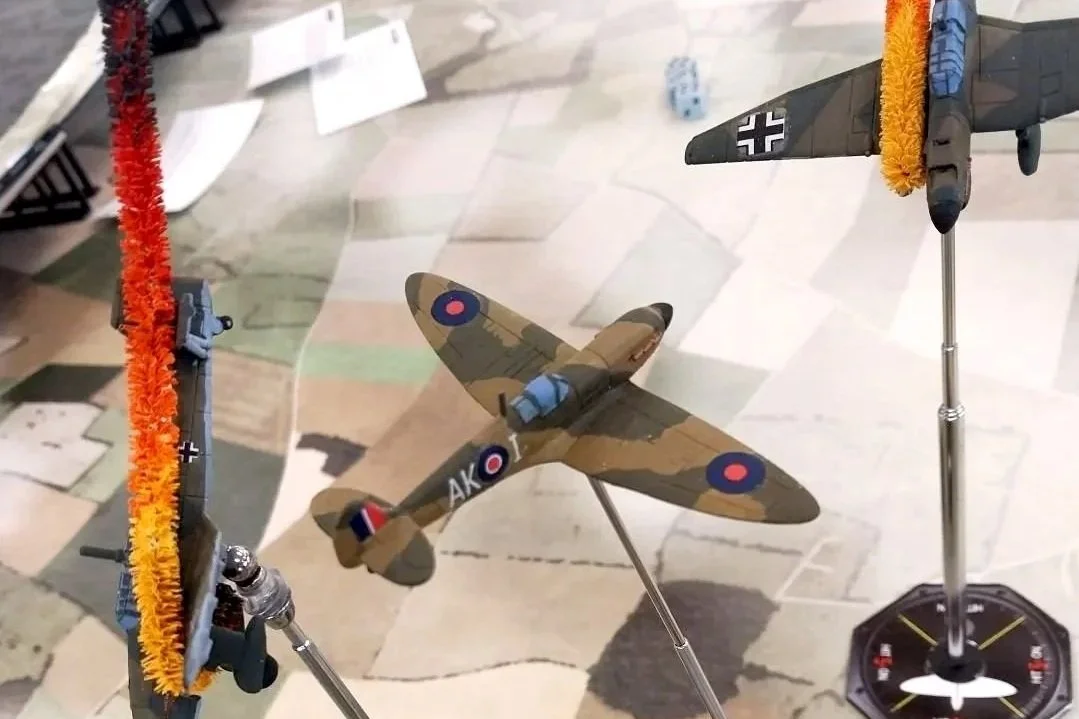
Angels One Six Designer Interview with Phil Yates
Heed the siren. Grab the stick. Miniature wargame godfather Phil Yates gears up for reimagined dogfighting with Angels One Six.
As a guy who loves looking at models and fantasizing about vivid battles more than I like painting or learning combat rules, I was fascinated by the claim that Angels One Six — a forthcoming WW2 dogfight miniature game from Phil Yates and Ian Bourgos — could get just about anybody up in the air.

Miniature wargame mastermind Phil Yates has reimagined the WW2 dogfight and wants to drop you in to the cockpit for the Battle of Britain
As I learned in my talk with Yates — father of Flames of War and many others — beautiful pre-painted planes right out of the box were just one of many obstacles he removed between a player and a bracing dogfight that was both realistic and accessible.
He walks us through the Angels One Six system, his multi-decade quest to improve everything from how a turn was taken to the stands on which your Spitfires and Messerschmitts sit.
If early event demos in his home of New Zealand are any indication, it appears as if Yates and Bourgos have succeeded in their quest to balance technicality and story.
This fall a Kickstarter will let you and your friends cut your teeth on some famous craft from the Battle of Britain, with an eye to expanding both to late-war planes and the Pacific. No painting required. Stay abreast of the project here.
Further recommended listening for hardcore miniatures people: Check out Yates’ talks with the excellent Lead Pursuit podcast hosts if you want a deeper dive (or a steeper climb) into the making of Angels One Six.
A very different war story: Hear an interview with Chicago ‘68 designer Yoni Goldstein.

Tracks of the Week: The Geto Boys Spike King Curtis’ Soul Recipe
A track recipe travels from Memphis to Jamaica to Houston’s 5th Ward, gaining exciting new ingredients.
I’ve got three recipes for you: one for soul, one for rocksteady, one for dope.
This recipe book starts in Memphis, stops in Jamaica, and ends in Houston’s 5th Ward.
If you like a tasty buildup where the track — sometimes with the help of a human tour guide — shows off its elements, one of my faves is “Memphis Soul Stew” by King Curtis and the Kingpins, where he breaks down all the ingredients that went into a classic Memphis soul track:
It wasn’t long after that that rocksteady giant Lyn Taitt and his band heard that, liked it, and made a Jamaican version of the recipe in 1968:
About two decades later, the Geto Boys are bullying their way into the national gangster rap conversation and putting Houston on the map through sheer force of will.
They raid Curtis’ original composition for samples, but add exciting regional ingredients:
I don’t listen to a ton of Geto Boys or southern stuff in general, but as the years go by, I get a greater respect for that regional, highly motivational grudge that drove Scarface, Willie D and Bushwick Bill to grind as hard as they did.
Fair warning: The King Curtis-style buildup is playful in a “having fun at the trap” kind of way. The verses that follow are not.
Check out 50 Golden Era Hip Hop Deep Cuts You Must Experience

Crate Digging: June 2026
The best music curation blog you’ve never read and the heavy metal Carcassonne tee you never knew you needed.
5 Things I’m Watching, Playing, Reading or Thinking About
✍ Hobby Games Recce
Peter Schweighofer’s Hobby Games Recce is the latest addition to the vivarium of RSS feeds I keep as a second, slower, better internet. I like peering into the vivarium and seeing Schweighofer’s work there, earnest and professorial, as indispensable as lichen on a rock, patiently spreading and enriching the landscape as this father, history buff, and lover of games diligently blogs his world.
🎵 Five Random Songs
I got to know game designer Josh Buergel first as a fellow listener. I recognized in him the valiant directive of listening broadly and keenly in service of not only the recorded work, but the act of tending to supple memory and rangy curiosity. I was gladdened to see that in April, he refitted his Five Random Songs project to include not only his usual razor-sharp capsule writeups on things that surface in his playlist, but album and new release spotlights.
🎲 The Boardgames Chronicle’s Kingdom of Heaven Session Report
Now this is what I’m talking about: A session report that carefully places you in the setting, the strategic parameters, and a carefully rendered blow-by-blow of how player decisions created the story inside the pressurized guardrails of that scenario. You can scour it or breeze it and still come away with a vivid image of this game and the rush of its decision points. I love this shit.
✍ The Public Domain Review
Give me an 1,100-page tome about history and I’ll find a way not to read it. Feed me an era by zooming into art and words that come into the public domain every year, and you’ve got my favorite vocabulary, art, lit, and historical primer, all bound up in scholarly writing and gobsmacking peeps into the past’s feverish currents. This newsletter is the titan of my inbox. Be careful. You will lose an otherwise productive morning or two when this hits.
🎲 Daniel Solis’ T-Shirt Shop
There’s no shortage of clever, graphically adroit T-shirts out there that riff on tabletop themes. Solis stands out for the breadth and quality of his designs — including a recent entry that reimagines Carcassonne as a metal band album cover. You will likely find something on his page that will have you seriously weighing the tradeoff between, say, having your next meal or wearing one of these joints.
Have a rare and beautiful recco? Hit me up.

Track of the Week: The Beverly Hills Contingent Joins Soul Assassins
A nepobaby tale on its face, The Whooliganz’ joining of Soul Assassins birthed some fun tracks and an eventual production legend.
There’s some cool history and trivia behind this lost track, but let’s not overcomplicate it, all I really want to sell you is this feeling:
The Whooliganz, who sound like they’re about 10 here, were Scott Caan, son of famous actor James Caan, and Alan Maman, who later becomes the production legend known as The Alchemist.
These two guys met on the mean streets of Beverly Hills and got around enough to eventually get the attention of B-Real of Cypress Hill, who added them to the Soul Assassins crew, which also included House of Pain and Funkdoobiest.
B-Real shows up on the last verse here to give the track, and these two youngsters, the official Soul Assassins seal of approval. It’s a short appearance, but I still love the snap and construction of the line, “Oh, what a natural feeling/’Cause I’m the one with gun doin’ all the cap peeling.”
I think it was 1994 when the whole Soul Assassins caravan came to the Boulder Field House. I went with my roommate, Pogo.
I couldn’t roll joints, so I had one of those wooden dugouts on me with the ceramic one-hitter that looked like a filtered cigarette and popped up via a spring when you slid the top back.
While waiting in line I got super paranoid about the pat-down at the door. Fortunately, I was wearing sneakers that were so busted, the stitching had completely given on the entire left heel. I jammed it under my foot and limped through the entrance without incident.
We puffed the one-hitter and drank beer and got to see The Whooliganz, Funkboobiest, House of Pain and Cypress Hill in their glory.
There were tons of skinny skater-type kids there. B-Real’s crowd engagement trick for the night was challenging everybody to get two mosh pits going. The second pit was interesting. There was a big dude standing at the edge of it, built like a redshirt linebacker for the Buffs.
His version of moshing was waiting until one of the stoner kids came within reach, then grabbing them by the shoulders and hurling them. He was like a golden retriever in front of an automatic stick-throwing machine, bouncing back and forth on his feet, eyes sparkling, while he scanned for the next kid.
For the encore, all four acts came on stage. They did House of Pain’s “Back from the Dead,” Everlast rapping with the diminutive Son Doobie on his shoulders, all of them riding together that first big swell of label success in the purple-white stage lights.
Check out 50 Golden Era Hip Hop Deep Cuts You Must Experience
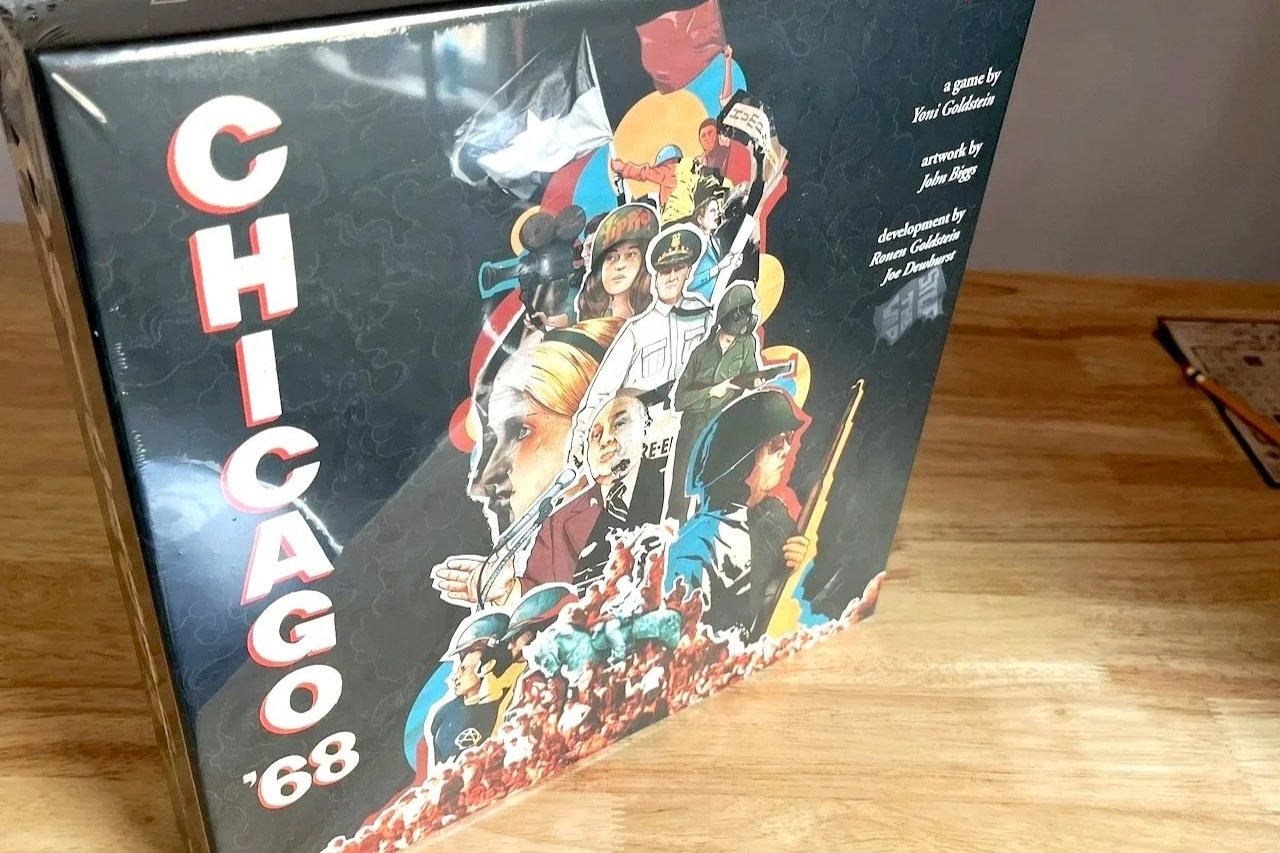
Chicago ‘68 Designer Interview with Yoni Goldstein
Chicago ‘68 designer Yoni Goldstein talks about how he modeled the three days of pandemonium during that infamous summer.
After interviewing Chicago ‘68 game designer and filmmaker Yoni Goldstein, I pinged The Moms — who grew up in Chicagoland with her four siblings — about it. She told me one of my uncles had been driving a cab in Chicago during that summer. He’d somehow been caught in one of the many fracases and had some teeth knocked out.
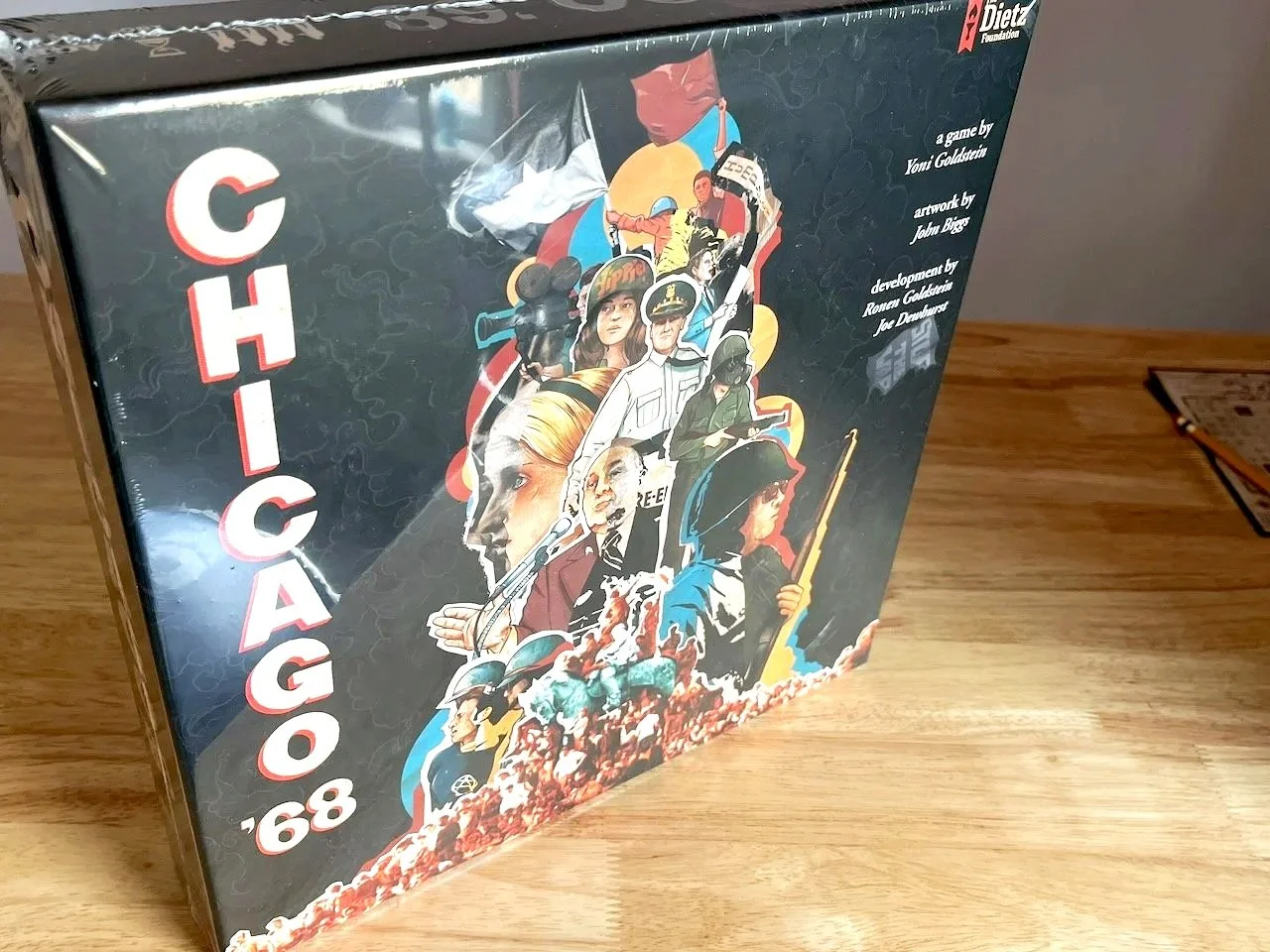
Chicago boils over: From one to four players can get a lungful of teargas as the establishment cracks down on the activist groups that descended on the city for the 1968 Democratic National Convention.
More than that I don’t know. But it was more than the setting and incidental family connection that got me on a recording line with Goldstein.
Encountering Vijayanagara: The Deccan Empires of Medieval India, 1290-1398 sharpened my general interest in titles that focus on other pockets of history, model other modes of conflict.
How did Goldstein choose to model the pressure cooker of the Chicago streets as activist groups — MOBE, the Yippies — tangled with the Chicago Police Department and Mayor Daley’s administration?
He answers that in spades. As he draws the system, the conversation turns to the era at large. I learn, among many other things, that French underground writer Jean Genet snuck into the country to connect with the leftist vanguard there. We touch on the William F. Buckley-Gore Vidal debates, a more genteel version of the Chicago clash mirrored on TV during the Republican National Convention in Florida.
We also learn about Yoni’s next project — a game that focuses on the Luddite rebellion in England — in this far-ranging and toothsome chat.
Like playing the historical underdog? Check out my review of Resist! and Pavlov’s House

Ghost in the Shell TTRPG: Preview Designer Chat With Alessio Cavatore
Designer Alessio Cavatore teams up with writer Zach Barouh for a plum assignment: Make Section 9 playable and faithful to the setting.
How does your first day as a Section 9 agent play and feel?
Designer Alessio Cavatore and writer Zak Barouh had to answer that question when Mantic Games acquired the license to translate one of manga’s most beloved franchises into a TTRPG: Shirow Masamune’s Ghost in the Shell.

Alessio Cavatore’s extensive track record in miniature and skirmish games — and his love for the original material — prepared him well to tackle Ghost in the Shell’s fast, lethal world of combat and ideas
Breakup Gaming Society’s resident indie TTRPG curator Walton Wood leads a talk with the disarming Cavatore, who talks about the thrill of being able to use all-original art from the manga and the collaborative challenge of making a system that was true to the beloved (and very dangerous) setting.
The toughest design conversations for Cavatore and Barouh yielded some of the most interesting fruit for GMs and players: Formalized tools for developing agents’ inner conflicts and richer storylines; bringing the original work’s philosophical underpinnings to the fore while quantifying the mix of augmentation, tech, and weapons that make combat fast and lethal.
Any firefight could be your last. Any mission could render your agent a burnout.
Cavatore’s depth of field in design, his giddy enthusiasm for the source material, and how he reveals himself as both a maker and a player made this one of our best recent talks. Check it out in the player above.
The Ghost in the Shell Tabletop Roleplaying Game launches in Summer 2026 from Mantic Games — hit the BackerKit page for more.
I’m seven sessions deep in Dwelling, a solo RPG for ghosts.
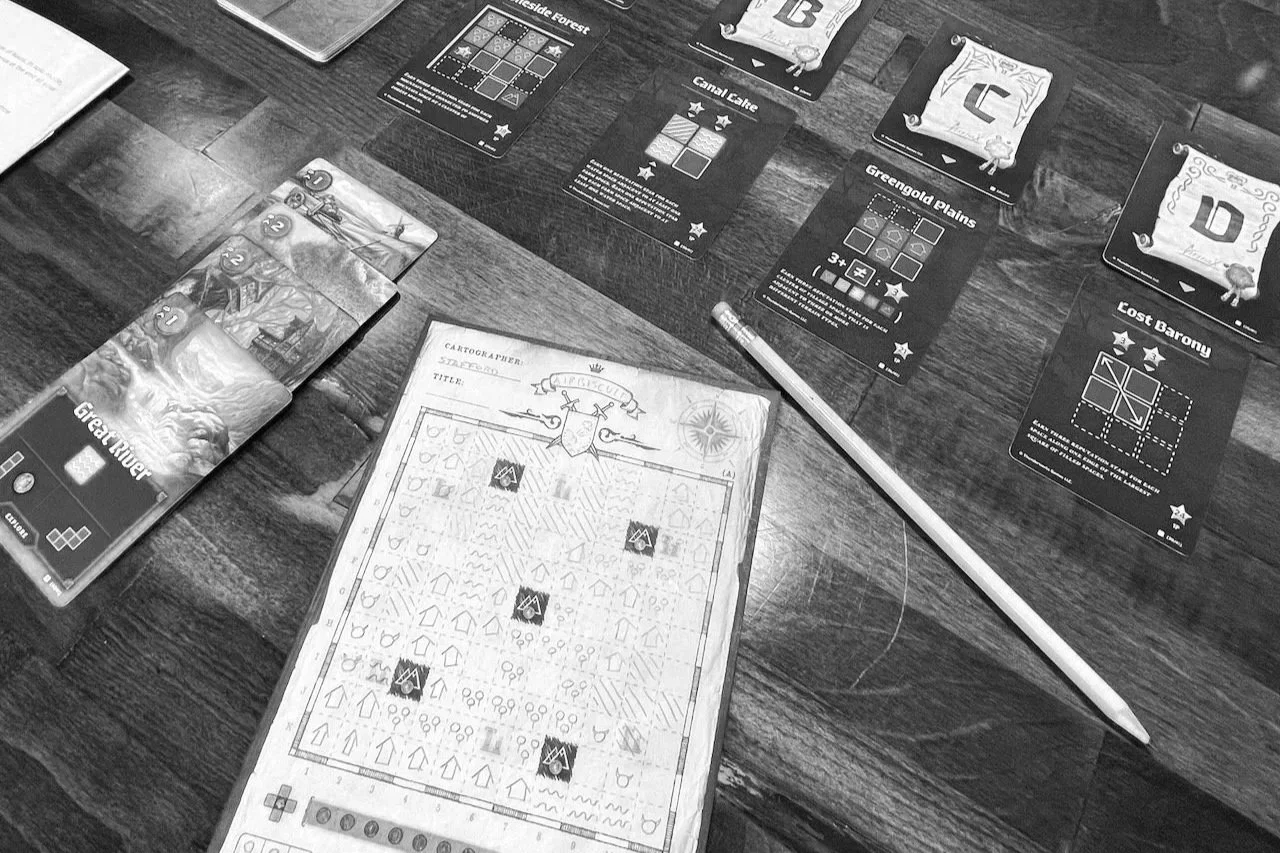
Cartographers Solo Flip-and-Write: I Was Fired After My First Play
My cartopher was attacked by gnolls who urinated on his lunch, but I still enjoyed this flip-and-write and intend to play it some more.
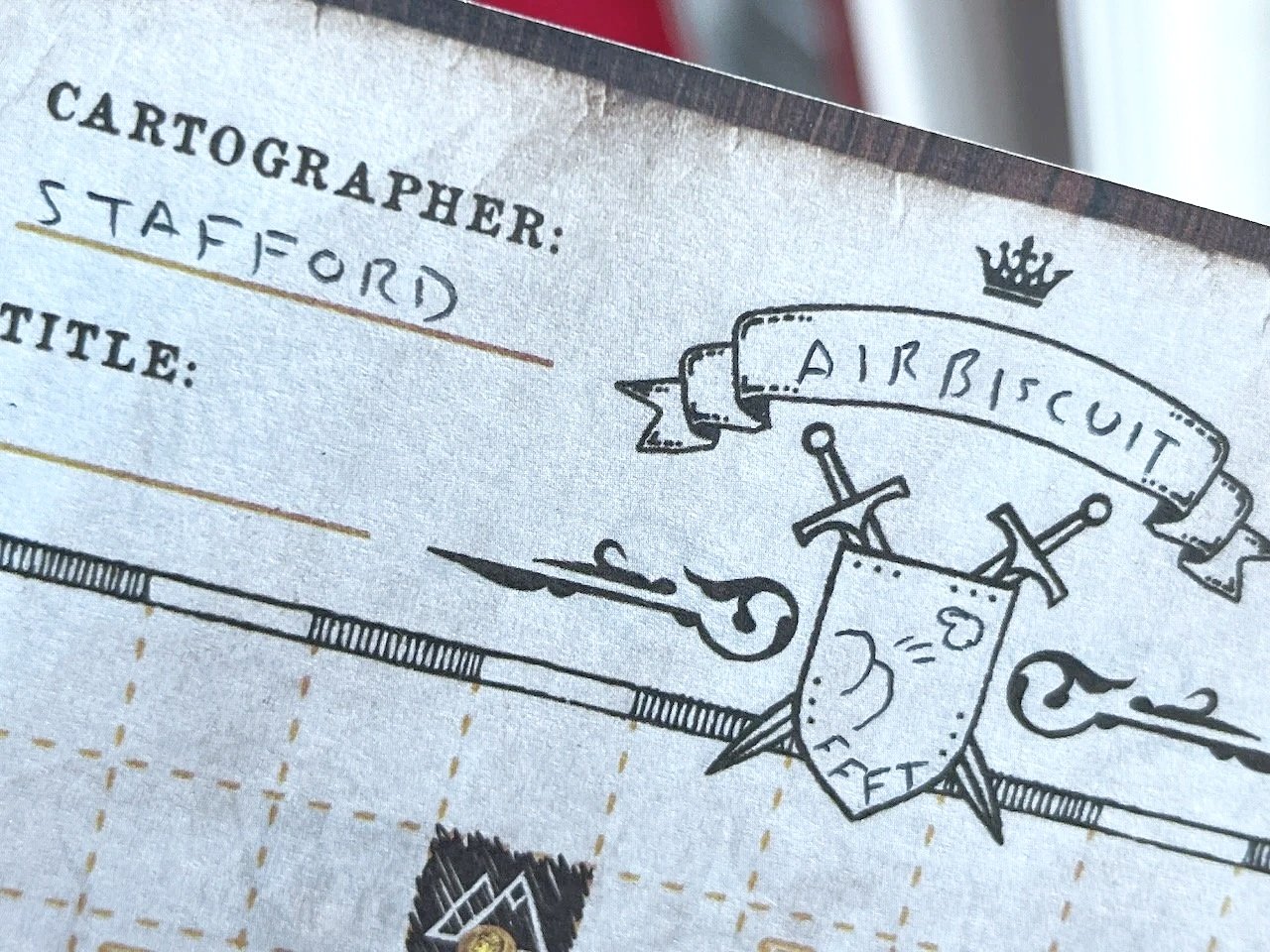
Cartographers Play Sheet: Rookie mapmaker Stafford Airbiscuit may not be a “culture fit” for this kingdom
As the backstory goes, the great Queen Gimcrack has just strong-armed a fat chunk of land from some other weakling, and it’s my job to help map it in the name of the Great Kingdom of Naloxone.
My name is Stafford Airbiscuit. I am a cartographer.
“Will the mission be dangerous?” I ask the queen.
“Probably,” she says. “Now get your little pencil out there and zone this thing.”
“How shall I zone it?”
“I don’t know yet,” she says, “it depends on where the mass graves are and how quick we can get residential developers on board. Keep an eye out for my edicts. And don’t put two artisanal burger places next to each other, it messes everything up, ‘kay?”
***
So it is my adventure with Cartographers begins — a game that continues to rate highly in the tabletop community among the past few year’s crop of move-and-write, flip-and-write, roll-and-write games…basically puzzles and engine builders where you attack a particular setting with paper and pencil trying to combo high scores based on where you mark things on your map or playsheet in response to the game’s challenges.
In Cartographers, the challenge is placing strips and chunks of polyomino-shaped terrain — villages, streams, forests, and farms — onto a newly acquired land. This land was won with the utmost probity and respect for international law.
The job description for my Cartographer, Stafford Airbiscuit, will be a lot like yours: You’ve got four seasons to do the job. During these seasons, changes in policy or the Queen’s blood pressure means the terrain patterns you’re trying to place will be rewarded in different ways depending on which exploration cards and scoring cards are out. Those cards also contain some curveballs, like finding Ruins that constrain your placement choices or pulling a monster raid from the deck, which crowds your map with unwanted symbols that drag down your score.
Hadrian’s Wall was my first experience with this school of design. I talked about that back in Episode 90. Hadrian’s Wall’s historical flavor, action variety and resource-heavy scheme kept it on my table for quite some time.
Cartographers is much simpler, which is the whole point; what I’m after here is something light and fizzy with a little pulp: Something refreshing in between learning sessions of Comancheria: The Rise and Fall of the Comanche Empire, which is still hogging up my main table with its intricate procedures and massive scope.
So I sit down with a pencil and walk a few solo turns. Using the short and clear rulebook, the few solo turns quickly become my first game.
The turn framework is pretty simple and the conditional stuff is easy to get your head around: Set up a season, see which two scoring cards are in effect, then draw explore cards that show you what terrain types and shapes you have to work with.
***
I had an easy time with the mechanics, but not a particularly good game; Stafford Airbiscuit has to go back to the queen with a score of 37. Which translates into a job rating of -45 per the solo grading rules.
“So what were we doing out there, exactly,” she says, holding my map incredulously.
“Well, the goblins kept attacking and the gnolls stole my lunch and went to the restroom on my lunch…”
“And did they also force you to place these two farms in zones where we don’t even get tax credits? I specifically addressed this in Edict B. Did you get it?”
“It was in the same bag as my lunch. They didn’t even eat the lunch, that’s what was so hurtful and sick about the whole thing.”
“Listen,” she says, closing her eyes and pinching the bridge of her nose, “we covered gnolls in the kickoff meeting. Do me a favor, draw a timeout space somewhere on this map and get your head together. We’re trying to map a kingdom here, this isn’t adult daycare.”
Looks like poor Stafford has a lot of improvements to make if he’s ever going to become a proper cartographer.
There are still 99 map sheets on the pad. That’s plenty of chances to get better at reading the shifting cards for opportunity and scanning the map for better placements — and figuring out how to draw a house better. I still can’t believe how bad my houses look when I fill in a village space. It’s really starting to bother me.
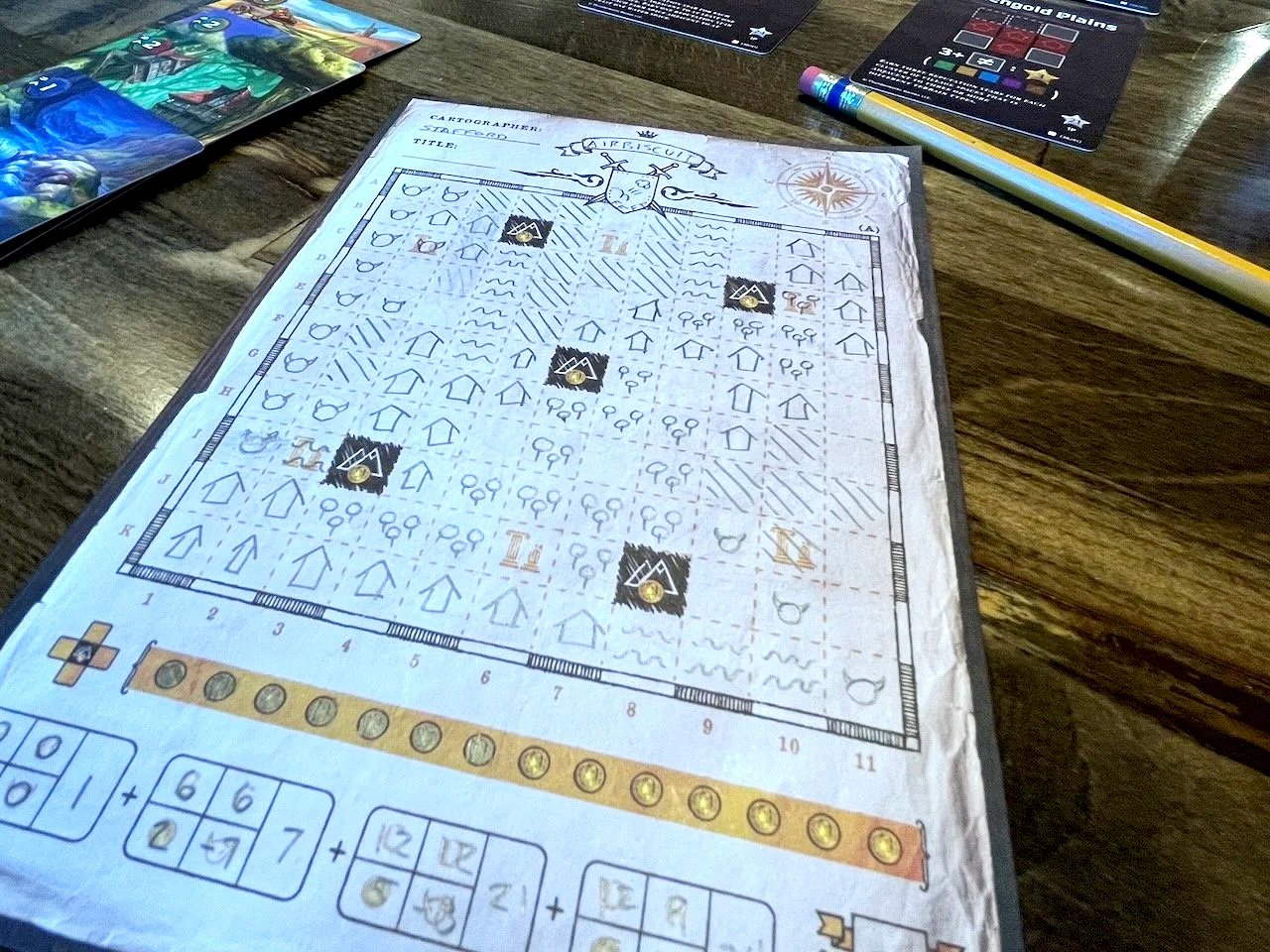
My game 2 playsheet: Better than my first game’s score, but I’m still fired
If you like this style of game, check out my Hadrian’s Wall review.

Tracks of the Week: Motion Man’s Brilliant Work With Kool Keith and KutMasta Kurt
Motion Man’s extensive work with Kool Keith and KutMasta Kurt is a monument to indie talent.
“Motherfuckers oughta let me go and finish this motherfuckin’ album,” says Dr. Dooom’ (Kool Keith) on “No Chorus” from the Dr.’s First Come, First Served LP. “The name of this song is I don’t want the motherfuckin’ chorus.”
I listen to it several times a year. In terms of rants barely glued to hurried bars, it’s Dooom at his daffy, cranky best:
How many cats can look back at their flash-in-the-pan ascent and realize Dooom had them dialed in a long time ago with the terse performance review he tacks on to the end of the cut? “I’m a tell you straight, look in the fuckin’ mirror, you’re wack. That shit don’t sound right. The mixdown ain’t right. Your vocals are too low. Your fuckin’ cadence is off. Stage show is weak. Fuck you.”
I get stuck on another one from this LP on my last revisit: “Housing Authority” featuring Motion Man. KutMasta Kurt’s spooky and efficient mix gets more addictive each time. I hear more technique and connective tissue in the rubbery braggadocio as Dooom and MM trade verses:
One of Motion Man’s tracks came up in my feed years ago. I had to track it back down. It was from his 2002 album, Clearing the Field. Also KutMasta Kurt producing, with guest shots from Kool Keith, Biz Markie, Planet Asia and E-40, the last two from the Bay Area, where Motion Man hailed from.
The dude just had style to burn, so many gears, as he toggled between schemes and techniques. Put it with one of Kurt’s most get-up beats on the album and you’ve got this: a monument to underground talent I keep visiting, wondering how I missed it on so many previous trips. This trio was productive, also uniting for the Masters of Illusion LP, among other efforts.
Check out 50 Golden Era Hip Hop Deep Cuts You Must Experience
Learning Thunderbolt Apache Leader: An Improving Commander’s Notebook, Pt. 2
For a two-day span, my desperate fight against living in the 21st Century is a triumph.
I’ve decided to spend as much of my remaining life as possible in the 20th Century.
I’ve taken my measure of this one and what I saw of the last. This one is ass. They told me I had to have a phone to read a menu the other day. Get the fuck out of my face with that. Mark Zuckerberg doesn’t need to be over my shoulder when I’m picking out lunch or on my nightstand when I’m making up filthy songs before bed.
Board games and books offer partial migrations — time zones where I can operate and think at a pre-digital pace. Tea and lots of water in the morning. Jot in the journal — I’m already getting sick of the narrator and his complaints — or read something. Get out for a walk.
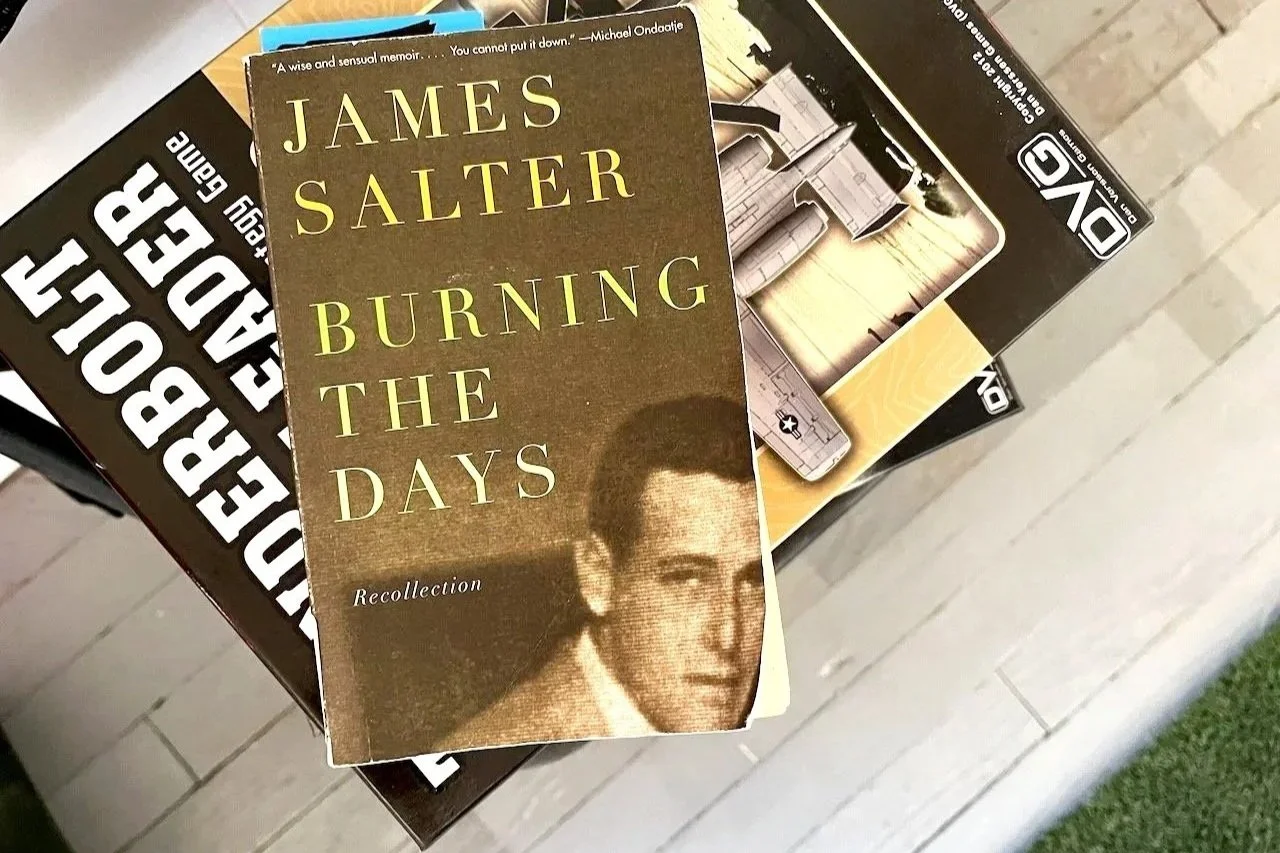
I’m re-reading James Salter’s Burning the Days and found this from his prep school days:
I was a decent student and lagging athlete, an unknown at track and substitute on the football team. I remember a youth of friendship and no foreboding, though miles away, in Europe, war had already started. Not far from where we lived, in Yorkville, they were showing German propaganda films, Sieg im Westen, and later, Feldzug in Polen, and women in the lobby of the theater held out cans collecting for German War Relief. Battle’s distant sound. We sympathized with the British, naturally, and read with excitement, in newspapers that no longer exist, of the trapping by British cruisers of the pocket battleship Graf Spee in a South American estuary. Inspired, we invented our own warship game, brilliant as only schoolboys could make it, with complex rules for movement, engagement, damage, and resupply, maneuvering fleets of slender model ships on the bare wooden floors of apartments in endless fights, often with diagrams and accounts written up afterwards, word of it passing down, so that years after, people who had never seen but only heard of it asked to have it described.
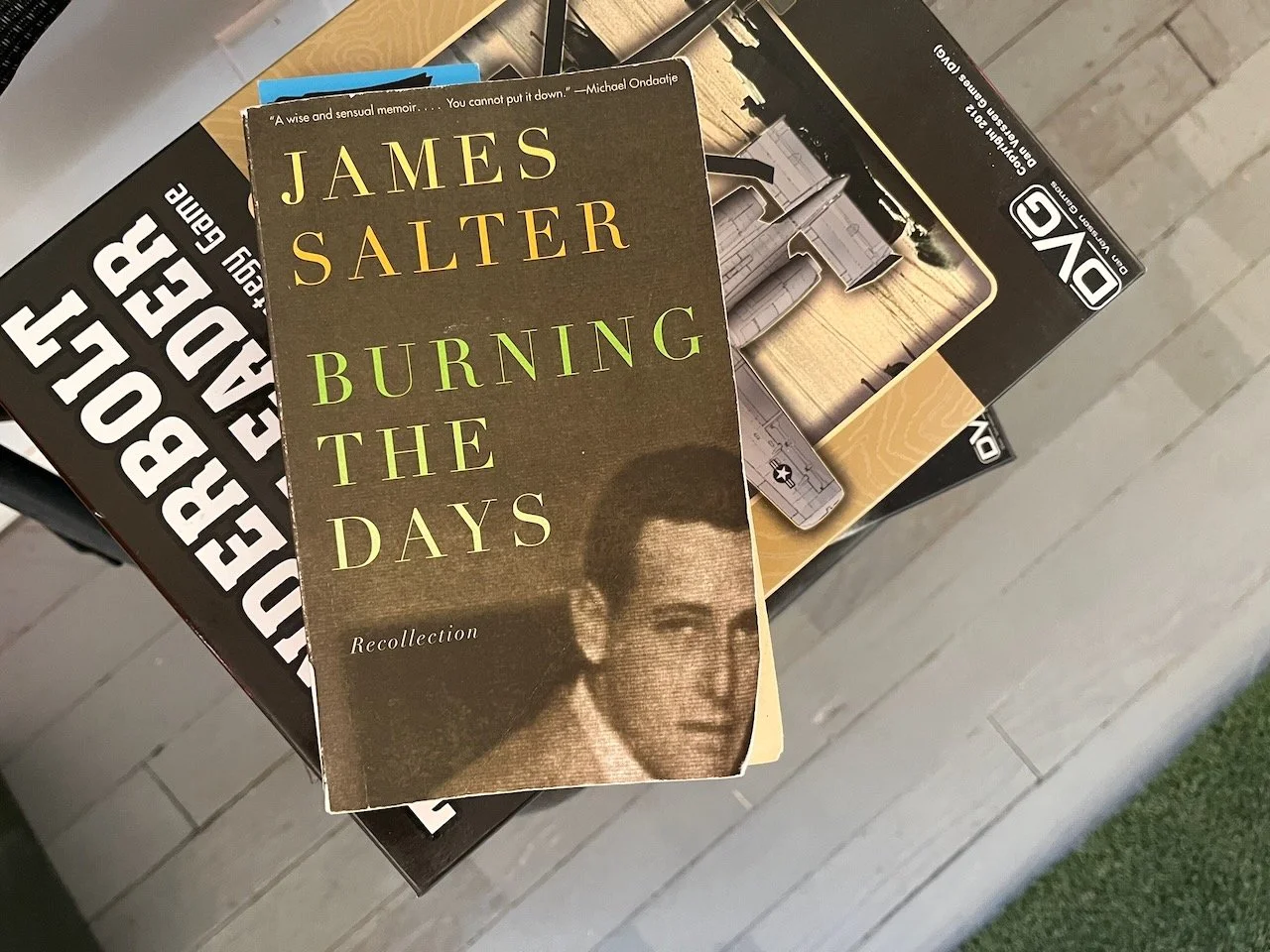
Jimmy was a goddamn magician with a sentence. Pick this one up.
I first read this book at 29, when I was dumb enough to think I could craft some personal recall as luminous as this. Re-reading it at 56, I know I never did and never will.
But I re-read it to study his technique, re-experience those sentences that curl and glow like old paper in flame. Maybe he torched his journals afterwards and decided to name the book that way.
Thunderbolt Apache Leader is another private cavern of stories I refuse to forget. The new games can wait. I pull it out and run missions as a reward for getting steps done in preparing taxes, which is intrusive and undignified.
I know I’ve done the right thing when I slot the new mission sheet onto my black clipboard and pick out a sharp new pencil. Here’s how it started:
Mission: Iraq
Situation: Cutoff
Craft and Crew:
• A-10A (Halo and Rebel)
• F-16 (Mohawk and Dart, Dart upskilled for 1 SO point)
• AH-1 (Freak and Grandpa)
• AH-64A (Rock and Shadow, Shadow upskilled at Rock’s expense)
Strategy: Iraq is a forgiving region in this game, but the Cut-Off situation bears some thought. I blow about half my Special Option points on a sampler platter of craft and two Scouts.
The A-10A and AH-64A are designed to be paired against the heavier battalions, with a better-than-average pilot for each craft. Or swap out the Apache for the F-16 if I need more payload to get it done.
I allot two pilots with the Fast ability for the F-16 and AH-1. As the Cobra isn’t very durable, I plan to use it in a hovering starting position at the beginning of a mission, hopefully with LOS on high-value enemy targets that haven’t had the chance to go to cover yet. “Dump everything in the mag and run” is my doctrine for keeping this little chopper in service for five days.
The F-16’s job is to roar in and hunt down choppers and the most dangerous surface-to-air units, with a couple turns after to hunt. The greeting card is a Maverick/GBU-16/Sidewinder mix so Mohawk can slice across the map once or twice and knock out their sharpest teeth before they can bite back. It’s always Mohawk, unflustered by all. His understudy, Dart, never gets a turn in the seat.
I want to keep these visits brief as the F-16’s speed means it usually has to climb to high altitude and attract lethal Pop-Up Units — or else make a bunch of hairy ridge maneuvers all the time, which is not Mohawk’s deal. He was an enfant terrible in his gunnery courses, but he regarded finesse low-altitude flying as cumbersome and pedestrian. Falcons are only interesting at height and at speed, he reckons.
This is the first time I’m trying this approach.
I walk setup, taking my time with it. In its three years on my table, Thunderbolt Apache Leader is the most exempt from setup fatigue.
Some say it’s fussy, especially with the terrain and enemy battalion setup and breakdown for each individual mission. They’re right, but it’s an additive, like the overture music you used to get in theaters when movies still had intermissions and scenes that bustled with titanic human effort.
It might be my favorite part of the game, perhaps something akin to what a D&D player feels when picking out their character or getting the dungeon map ready. I can happily spend half a morning on it, the ceremony is like a drum line slowly building in volume.
I am not efficient, but I am engaged and delighted.
The Action
Day 1: Shadow and Grandpa are dispatched to take a bite out of Mechanized Battalion 3A. I send the F-16 and the A10-A — Mohawk and Rebel in those respective seats — to hit Artillery Battalion 1S and prevent the game-long drain on my SO points from that unit’s persistent effect.
Neither mission fails. Both battalions are halved. Mohawk, chosen strictly for his itchy trigger finger, hits his marks and flies off, leaving Rebel enough loiter time to scour hexes in an attempt to destroy the battalion, but he could not capitalize on any in-hex cannon strike opportunities.
The chopper jockeys fare a tad worse and would have failed had it not been for a single, shocking four-for-four Hellfire and BG-71 salvo from the Cobra.
Generally mediocre gunnery clouds what could have been a banner day.
Days 2-4: I am spellbound and neglect my end-of-mission notes. But the plan works on the whole. There were two Command units with persistent negative effects; one I hit hard enough to stop the SO point drain, but the other pushed the Assault and Support units at me top-speed for the duration of the campaign.
I did well by keeping a pile of SO points in reserve for the five-day drought, but that meant flying light sorties that were rarely able to KO a battalion on the first try, necessitating mop-up runs. While the enemy bulk was modest, what was there moved quickly and threatened me with a mission failure at the end.
I’d lulled myself into complacency a bit; never before had I hit Day 4 of any mission with pilots and craft in such good shape. The end-of-day assessment jars me: I was down to fewer than 5 Special Option points and three Assault units, even the battered ones, had pushed into the Friendly Rear band.
I calculated that I had to wipe two of them to survive the Special Option penalty if the remainder moved at all — which they were likely to do, as I’d left the Command unit that coordinated their rapid movement undisturbed for the entire campaign.
Day 5: Grandpa and Shadow (my first-ever in-game promotion to Veteran) are assigned the remnants of a Reserve force that will gain the base unless removed. An MLRS barrage and a brisk flyover by the whirlybirds breaks them.
This leaves another “must destroy” job for the jets against a halved, but still substantial, Infantry force. Mohawk does what he’s done the whole game and leaves. But the battalion is still at functional strength. It all falls on Halo again. The last path through and out is a three-hex canyon gauntlet, including three Pop-Up units summoned by Mohawk’s glib, high-flying ways.
Halo acquires and smokes the most dangerous Pop-Up Units, but the ground fire is withering and none of those intrepid strikes count against the battalion goal. The penalty exacted by the HUD damage sends Halo’s secondary volleys wide.
By the time he limps to the exit hex, all the loaded munitions are gone and his nervous system is just about on tilt. The A-10A has sustained two structural hits as well as damage to the engine, HUD, pylon and controls.
The math says I’ll destroy the battalion if Halo can use his nose cannon to pop a lone APC in his exit hex. He moves to the one-way exit side of the hex on his nearly exhausted fuel tanks, fires a burst. Nothing.
That leaves one shot if he opts to fire before moving on his next and final Loiter Turn. The roll is heavily penalized and I imagine him trying to eyeball it in his cradle of noisy alerts on the last circle-back he can afford to make.
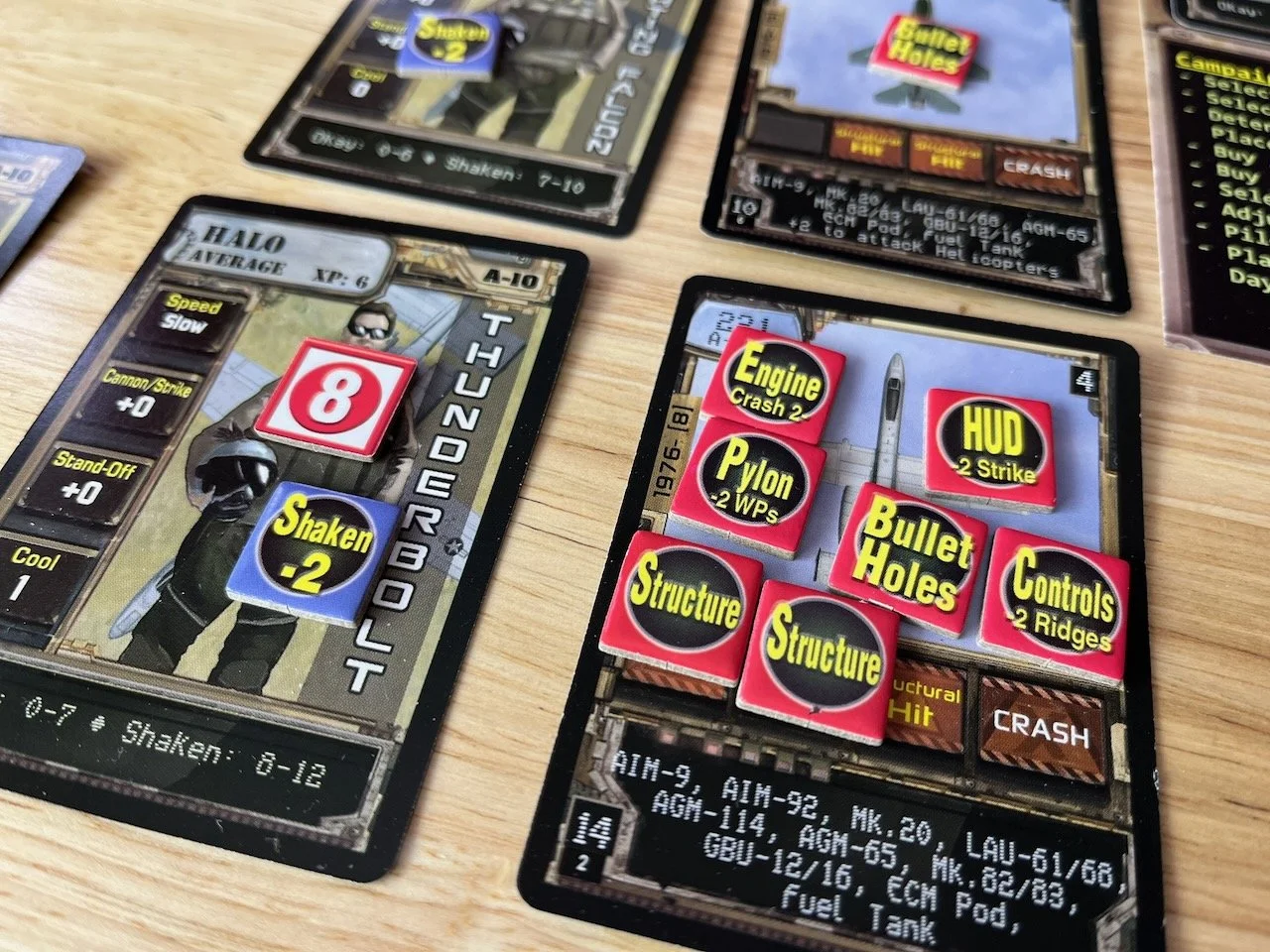
Thunderbolt Apache Leader: Fly it like you stole it, Halo; end of last mission, Day 5
The die displays an 8 before serenely scooting an extra millimeter off my table. I don’t want to look at it as I pick it up. It rolled a 9 after hitting the floor, surely siphoning off the last good fortune from whatever bank holds these reserves.
I pitch it again. An 8.
Halo tacks to the base en route to a promotion of his own. The Cut-Off conditions that award SO points for killing battalions give me the cushion I need to absorb the penalty when the surviving enemies head for my base.
All told, I earn a Good rating with 16 net VPs.
***
Here’s Salter again, talking about his childhood reading and re-reading of Kipling’s “Ballad of East and West”:
I did not invent any games for the poem or pose before the mirror as one of its figures; I only stored it close to my heart. In the end, I suppose, I found the poem to be untrue, that is, I never found an adversary to love as deeply as a comrade, but I kept a place open for one always.
Of the cardinal virtues, it was fortitude the poem held high, perhaps with a touch of mercy. Fortitude, I saw, was holy. My life was too meager for me to know if I possessed it. I was white-skinned, sheltered. In the street I ran from gangs of toughs. Tunney, Dempsey’s most famous opponent, soaked his fists every day in brine to make them invulnerable, my father had told me, to toughen them, and it was in some sort of brine that I hoped to steep myself.
Halo took a good soak in that barrel on Day 5. This is etched somewhere in gold leaf that fades as the disorder of my home and all the other undones come back into focus. A voice mail from an old friend that has to be listened to. Preposterous.
It is the first of many transmissions of the age that erase the magic, truer world, bleach that particular color of triumph from the page and the sky.
I don’t like even needing a computer to tell you about it, if I’m being honest.

Tracks of the Week: How to Lead Off or Close a Posse Cut Courtesy of Keith Murray and Kwest
Keith Murray shows you how to open a posse cut on “I Shot Ya.” Kwest shows you how to close it out on “5 Star Generals.”
I keep thinking about first lines in hip hop cuts because that’s the criteria Doghouse Reilly uses for determining which lyric goes on a shirt.
It turned into a sideline solo trivia game I play in my head all the time. It’s also infected my listening habits. Part of my brain is always scanning the first line when a hip hop track comes up on shuffle, which it does about 65% of the time.
The other day “I Shot Ya” pops on — a posse cut anchored by LL Cool J and also featuring Keith Murray, Prodigy, Fat Joe and Foxy Brown. It’s probably a bit too vulgar and aggressive for a Doghouse tee, so I’m gonna try to screenprint it on your brain instead.
Imagine you’re Keith Murray, already getting a lot of buzz for your work with Def Squad, and you get assigned the leadoff verse. The great LL Cool J has picked you for this five-minute farm team of potent rising talent.
What’s your first line?
Here was his solution:
“I’m here to make a dollar out of 15 cents/And let my balls hang like I’m on the toilet takin’ a shit.”
I wonder how many lines he jotted and scratched out on the pad before settling on that — an unrhymed, brash piece of idiomatic double-barrel provocation.
As a strategy, it makes total sense; walk right up and toss a bag of snakes on the poker table. In practice, I think it works because of the energy and level of commitment in that and the follow-up lines.
Now here’s a different one to think about — a master class in how to close out a posse cut. In 1998 Shabaam Sahdeeq puts out a 12” on the Rawkus label and puts a track called “Five Star Generals” on it — a convoy of underground talent with himself, AL, Skam and Eminem.
But at the end, it’s Kwest’s turn. You can go back to the preceding verses and check it out for yourself, but I’m confident in saying he just buries everybody:
I loved finding this track because Kwest’s debut LP is still one of my favorites. I don’t think Kwest really ever got his due. He was a big talent who got lost in various stages of label hell and shifting tastes. Those launch windows are brutally small and the world spins so fast.
There you have it: One example of how to lead off and another of how to finish a posse cut, courtesy of Keith Murray and Kwest tha Madd Ladd.
Related Listening:
• “Hostile” from Erick Sermon’s debut solo LP, No Pressure. This one features Murray rhyming with Sermon over one of the album’s many badass beats. I always love it when an MC starts a verse by yelling out his own name. Murray often boasted that he was the best of his class. He certainly raps like he believes it.
• Also check out a track called “101 Things to Do While I’m With Your Girl,” by Kwest tha Madd Ladd, whose delivery and wit make this one of the best entries of the “I’ll take your girl” song category ever. I would frame this right on the same wall with Big Daddy Kane’s “I Get the Job Done” and LL’s “I’m That Type of Guy.”
Check out 50 Golden Era Hip Hop Deep Cuts You Must Experience
Crate Digging: April 2026
My favorite small-channel tabletop YouTube find, a DJ tears up the 45s in a drum break seminar, two novels that touch on invented games, and Noisy’s impressive Fantasy Flight Silver Series collectin.
5 Cool Stuffs to Watch, Play, Read or Think About
📺 Rules Challenge
I can’t sit through an hour-long explainer video prior to learning a board game. I have to knock around the rulebook with the thing out on the table and course-correct with FAQs and BoardGameGeek. But Rules Challenge showed me a step in my learning process that I never knew I needed — getting a well-shot quiz on a bunch of situations from a game after I’ve gained an experiential frame of reference. I strained mightily in my first few solo attempts at SETI: Search for Extraterrestrial Intelligence. With two games under my belt, I stumbled across this gent’s SETI quiz and watched every minute. Massively valuable for me. In the last year, he’s also done Pax Pamir, Maria, Hegemony, Molly House, Dune: War for Arrakis, Unconscious Mind, Maracaibo, Arcs, and Ark Nova. Take a spin through one of these excellent videos, you might be surprised at how many finer points you’ve actually retained. My hands-down favorite small-channel tabletop find of the year.
📺 DJ Mark 7” Throwdown Vol. 1 (Breakbeats)
This is so fucking beautiful. And a nice “rules quiz” of your own if you think you know your classic soul/funk/jazz hip hop breaks. If you like watching a guy mix really well — and love tracing samples, like I do — this is one of your better music watches. Outstanding set, DJ Mark N, sir. This is edifying and it bangs.
📕 The Universal Baseball Association, Inc., J. Henry Waugh, Prop. by Robert Coover
This forwarded along from Breakup Gaming Society friend and contributor Fritz Godard: A reprint of a 1968 novel about a guy called “…Henry Waugh, an accountant who spends his nights running a solitary baseball league of his own invention. He conjures his Universal Baseball Association with dice, elaborate scorecards, and meticulous record books — but most of all imagination. Henry’s is a coherent, vibrant world, a closed system with its own history, genealogy, politics, and language,” writes Edwin Turner of Biblioklept. As somebody who has built imaginary campaigns and worlds of his own — and who honors the impulse in others — this looks fascinating.
📕 Burning the Days by James Salter
I first read this book at 29 and the simple — but not simplistic — bent of Salter’s lambent prose tricked me into thinking that I could write sentences of that strength about myself someday. Revisiting it at 56, I realize I never did and never will. Still I wanted to bathe again in the adventure of his life and the tender, controlled reed sound of this guy’s technique. And speaking of invented games, I stumbled across this passage from his prep school days, which I’d forgotten ‘til now:
"I was a decent student and lagging athlete, an unknown at track and a substitute on the football team. I remember a youth of friendship and no foreboding, though miles away, in Europe, war had already started. Not far from where we lived, in Yorkville, they were showing German propaganda films, Sieg im Westen, and later, Feldzug in Polen, and women in the lobby of the theater held out cans collecting for German War Relief. Battle’s distant sound. We sympathized with the British, naturally, and read with excitement, in newspapers that no longer exist, of the trapping by British cruisers of the pocket battleship Graf Spee in a South American estuary. Inspired, we invented our own warship game, brilliant as only schoolboys could make it, with complex rules for movement, engagement, damage, and resupply, maneuvering fleets of slender model ships on the bare wooden floors of apartments in endless fights, often with diagrams and accounts written up afterwards, word of it passing down, so that years after, people who had never seen but only heard of it asked to have it described."
🎲 Noisy Andrew’s Fantasy Flight Silver Series Games Collection
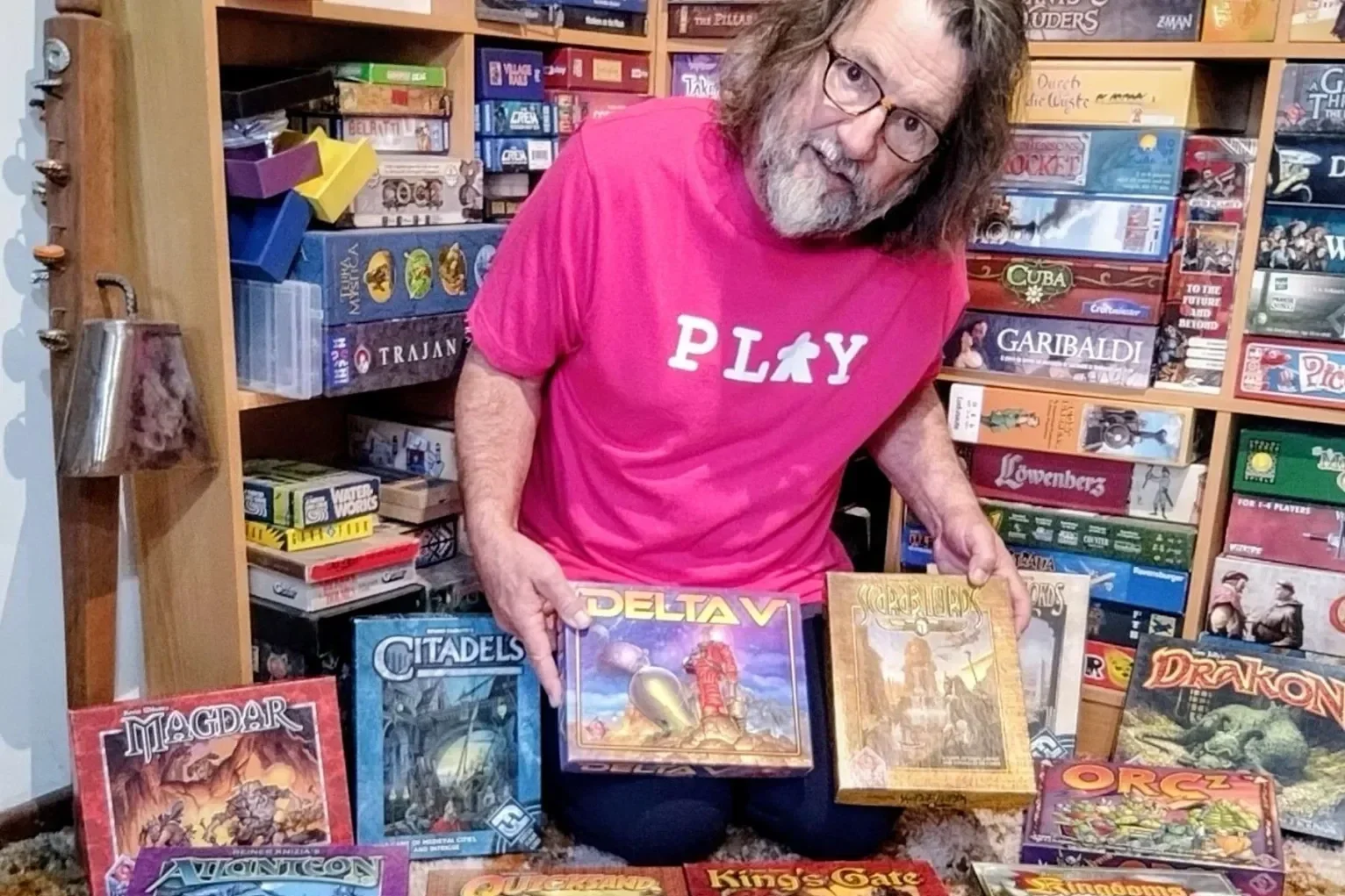
MY GAWD WOULD YA LOOKIT ALL THOSE FANTASY FLIGHT GAMES SILVER TITLES. Among his many interests, Noisy Andrew — Breakup Gaming Society’s Resident Boardgaming Big Bro — made a point of snagging every Silver Series box he could across the years. You’re looking at Magdar, Citadels, Delta V, Scarab Lords, Minotaur Lords, Drakon, Orcz, Atlanticon, Quicksand, King’s Gate, Kingdoms, Inkognito, Cave Troll, Maginor and Arena Maximus. Recently Noisy hopped on the mic with me to capsulize all of them, but we were having latency issues and we’ll prolly have to retake it. I only played one thing in this pic — Citadels — and I think we got some decent audio on that, which will be added and written up in Breakup Gaming Society’s living post on Fantasy Flight Games’ golden age, which also includes supplemental interviews with board game writer Matt Thrower and Shelf Stable cohost Kenny Katayama.
This project is burgeoning past my understanding.
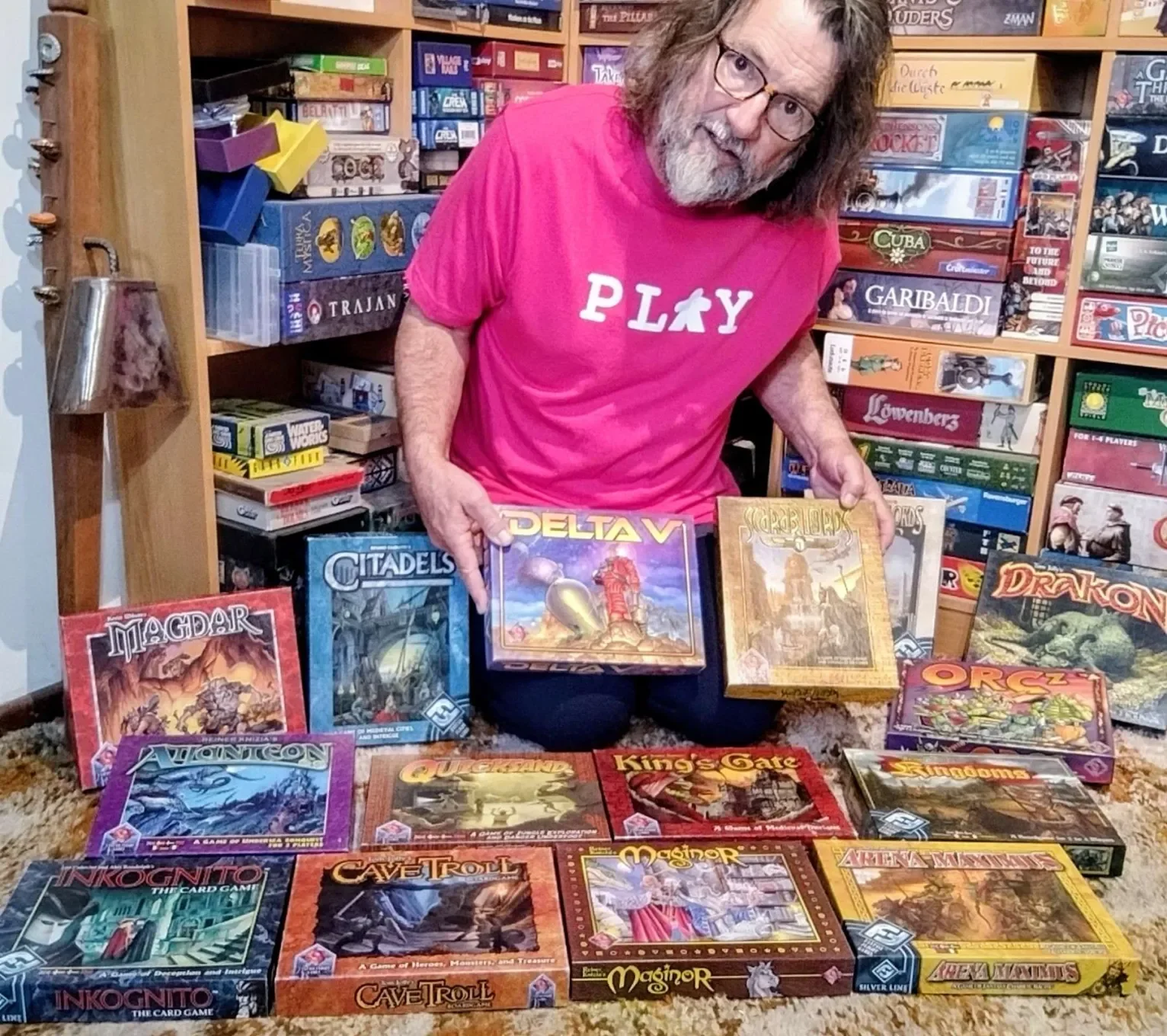
He’s played ‘em all, people: Noisy and his vintage Fantasy Flight Silver Series stacks
Have a rare and beautiful music or games recco? Hit me up.

Tracks of the Week: Latifah, Monie and Ultimatum’s Remix Magic
Two reworks of a track from Latifah’s debut, All Hail the Queen: The 45 King’s extended “Ladies First” and Ultimatum’s “Dance for Me”
Queen Latifah’s release of All Hail the Queen in 1989 was catnip to critics and the beginning of a veeeery good run for Dana Elaine Owens that arced from albums to the screen.
The tracks I return to most are both remixes of tracks on that album — and are both touchpoints for how hip hop and electronic acts from the U.S. and UK breathed one another in.
The first is The Crazy Extended 45 King Remix of the album’s most well-known song, “Ladies First.” Obvious UK tie-in here. Guest rapper Monie Love showed up and blew the doors off:
DJ Mark the 45 King (RIP) is the production name I most associate with this album, but Prince Paul, Daddy-0, KRS-ONE and Louie Vega also contributed to this breakout.
My second never-skip off this album is the Ultimatum remix of “Dance for Me,” which also has UK DNA in it. It also had more juice, mood and adrenaline than the LP version.
Ultimatum was a specialist remix outfit composed of the Stereo MCs camp — yes, fellow Americans, the outfit that had a big hit over here with “Connected” in 1992 — and DJ Cesare, who is listed as the Ultimatum remix point man and sometimes as a member of Stereo MCs. He had his beats and scratches in all kinds of projects and groups, from the KLF to Psychic TV.
It’s only fitting that where the US touches the UK touches hip hop touches dance music, you get a rich font of sample sources. If WhoSampled is to be believed, you’re getting pieces of James Brown and a Sly and the Family Stone medley track smoothly Frankensteined to a 1986 track from The The and bits of drums from post-punk legends Magazine.
You can’t deny how they put it all together over Latifah’s bright exhortations to get on the dance floor:
Some of my favorite co-minglings of hip hop and electronic sensibility right there, especially the urgency of the drum break.
What fun. I’m just gonna play some more of it while you add this to your playlist. My work here is done for today.
Check out 50 Golden Era Hip Hop Deep Cuts You Must Experience
Mix Up Fairy Tales: Interview With Warcradle Studios Co-Designer Robin Cruddace
Warcradle Studios’ Robin Cruddace talks to us about Mix Up Fairy Tales, a co-op family storytelling card game designed in collaboration with the British Library.
What happens when two designers from Warcradle Studios — Ziz Simoens and Robin Cruddace — get to raid the British Library’s sumptuous vaults of period fairy tale art?
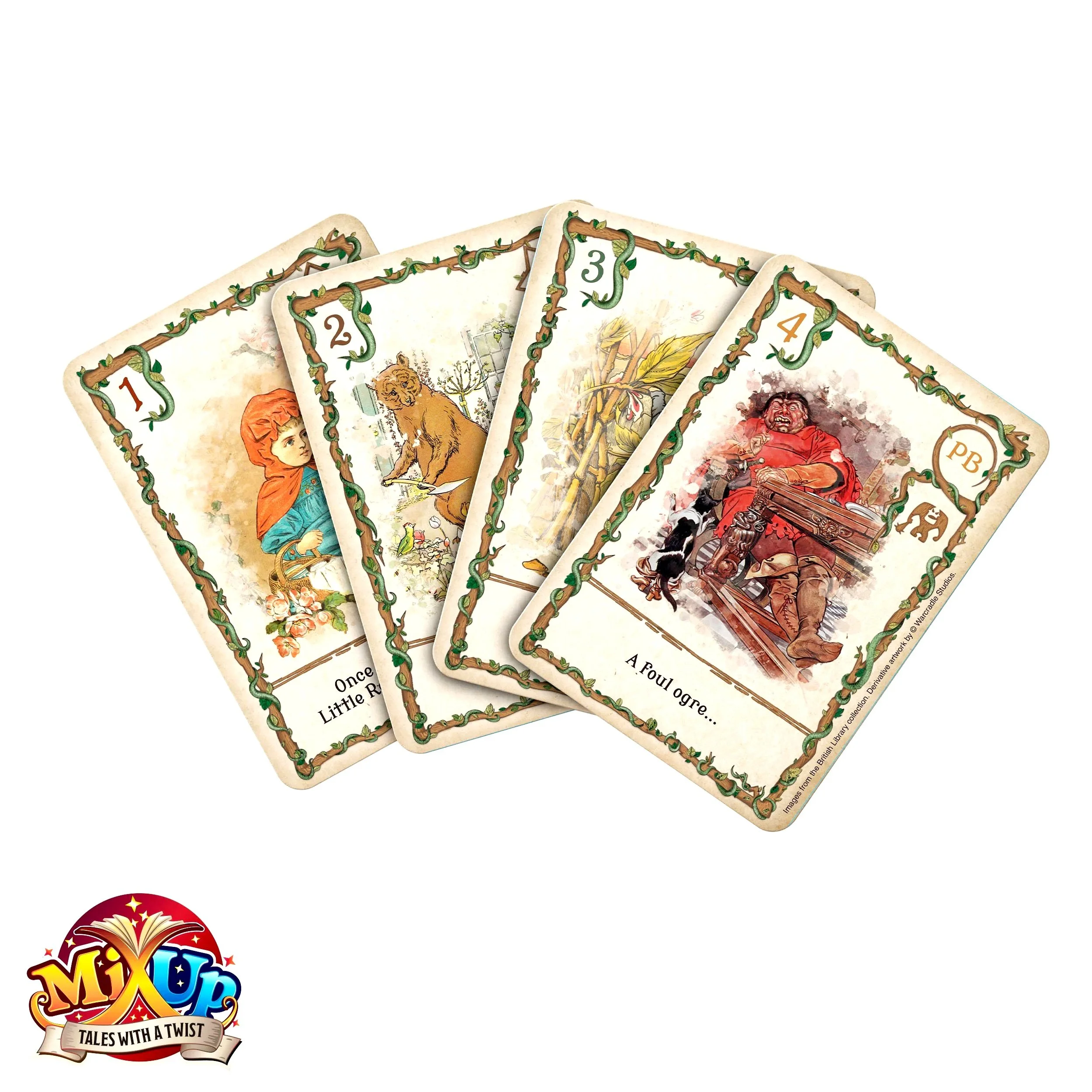
You get Mix Up Fairy Tales, a family card game where two to six players remix the elements of eight classic yarns simultaneously — with a milestone scoring challenge system that leavens the laughs with some strategy.

Mix Up Fairy Tales co-designer Robin Cruddace got some help forming the core play concept when his daughters got their hands on some prototype art. There may be lucrative consulting work in their future.
Puss in Boots can find himself contending with the giant from Jack and the Beanstalk, for instance. And if playtesting reports are to be believed, seeing Goldilocks pushed into an oven might be just as important to your group as meeting the game’s scoring requirements.
The project arose from the British Library’s Fairy Tales exhibit (running until Aug. 23, 2026 in London). The Warcradle team broached the possibility of spinning up a companion family card game.
Simoens and Cruddace were paired up for the design work, which included working with British Library staff to comb a massive stock of vintage storybook art. The game found its core concept when research artwork fell into the hands of Cruddace’s two daughters, whose spontaneous play with the cards revealed a direction that could engage younger and older players at the table.
Breakup Gaming Society host Nate Warren and contributor Walton Wood talked to Cruddace about the origin of the project, the concept of the game, the importance of multigenerational play and storytelling — and the surprises he found in both the stacks of the Library’s art and on the playtesting table.
Take a look at Mix Up Fairy Tales for yourself at Wayland Games or via the British Library Online Shop.
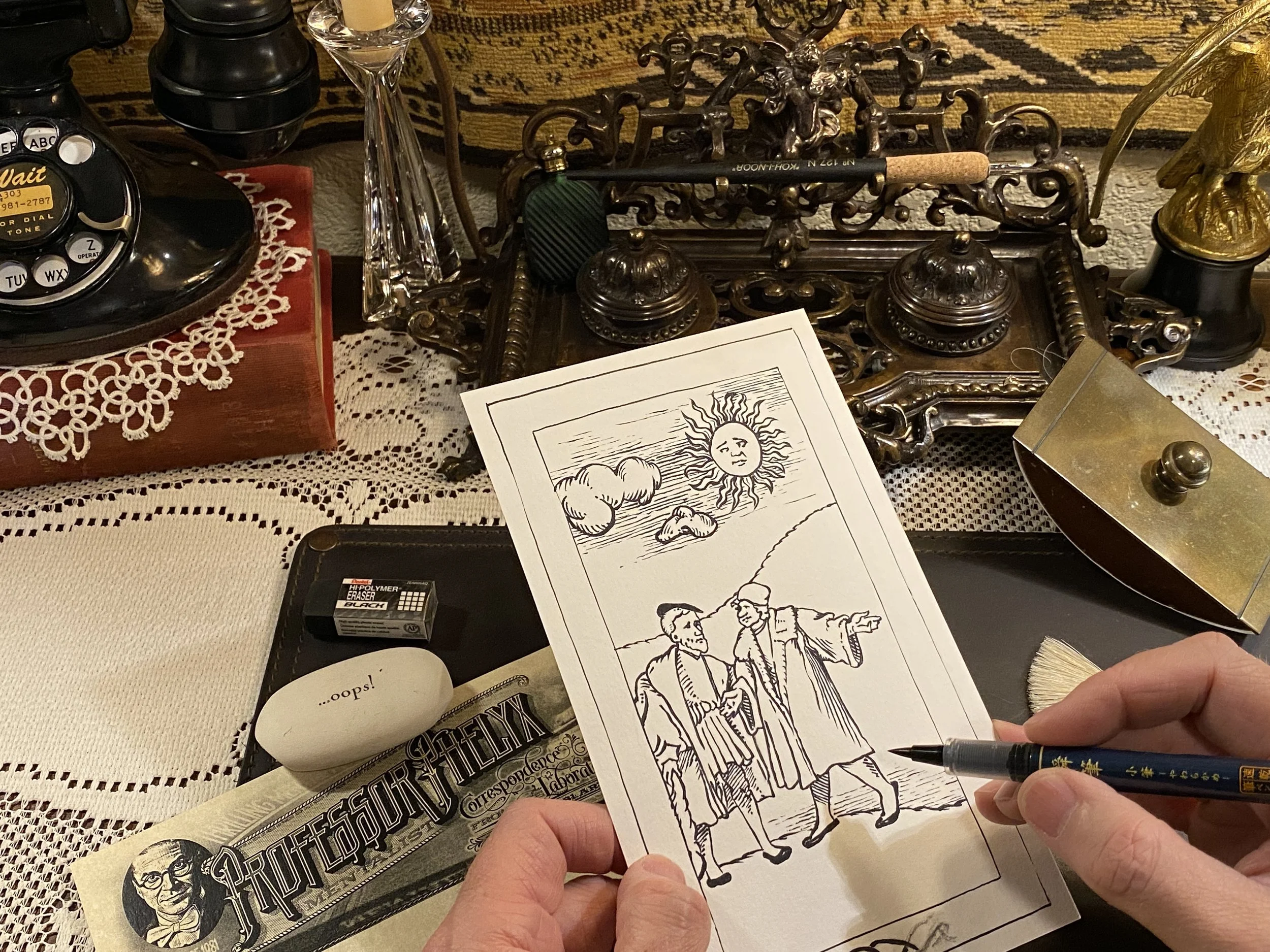
BONUS: Meet Professor Phelyx and learn about tarot’s history as a storytelling game.

Dwelling Solo RPG Session 7: The Gehenna Task List
Another rust-colored bird is admitted from a new door, which flaps out with a puff of ash and alights near my pillows.
BASEMENT
Conjure: The basement is bathed in a sickly red glow. Everything I imagined from the most fear drenched moments of my childhood are summoned here in the basement around me. Bodies, forms, beings etched into shadow, and wall, floor, and even the red light that is spreading through the basement.
They seem to mill around and at the same time not move at all: In the naming sounds of this hell, they are called CORdy, Derek, and molmolmolmolmolRIC, but also sometimes they are called Krabeltst or Elemena-tuh-tuh-tuh-tuh — or maybe these are simply other words they use often.
In the light of other places they would be handsome protectors or kids who could sell you something useful at a fair price, but here they will, with the same charming half-interest as in the other lights, help themselves to the marrow. CORDeeee or is it molmolmolmolmolRIC are in charge of a great camera rig, which they move around as they banter.
The rig is like a bulbous scepter of fused seeing devices with a single metal stalk and tripod, lenses of all sizes jutting out. It is not always clear who is holding or moving this array. They seem to understand not only which way it’s supposed to point, but that whatever it captures will not cloud one happy afternoon on patios full of the handsome and ravenous.
They don’t bother to issue direction or let me in on the script; they have already won in the last scene under the light of other worlds, I think. There are old Minolta 35mms and many telephotos, hooded security cams and phone screens; the Gordian recesses of their cabling glisten with fluids.
There are women also — maybe three, maybe four — called Mllllghean, and gribn and Melanimanianuhnuhnuh. These Friday casuals, they gather and chatter as producers or directors would with extras in earshot. It doesn’t matter if the help hears the plan. What are they going to do?
Their overlapping chatter is a train of rushing cuneiform cars at the edge of the bed…there is a bed now, by the way — an immense bed set violently against what I think the basement should allow.
I am naked under the comforter, the top edge of it arched enough to see the personnel. I am trying to burrow into the bedding, but the edges of it give with the room’s breath and the smallest gap, though a body’s length away, jolts my legs into fits of weak pedaling motions.
Some of the women stand, some sit at the edge of the bed as they burble to each other in the dream tongue. Simultaneously I want to be joined under there or left unseen, but in their talk, gales of oblique assignments batter me, planting false memories of emails or spreadsheets stacked with barked orders in the same unforgiving dialect.
I am being transmitted directions in the ur-language of every deadline, the soundbed of every two-minute span before you’re three minutes late — of hallways you failed to navigate in buildings where you didn’t belong.
The senseless instructions keep coming. Gribn and Mllllghean keep laughing and I want them to know I need either rest or touch, either will do. The boys reposition their rig for the fourth time, the air pressurized with the hatred of its seeing. I writhe again in the void of the blanket that refuses to cover or hide me.
I never noticed the small hinged door of the soot trap nor knew there was a wood furnace down here; there are several of these tin doors now set into the brick at irregular spacing, and Melanimanianuhnuhnuh or one of the others goes to one of the doors every so often, not breaking a sentence, and admits another rust-colored bird from a new door, which flaps out with a puff of ash and alights near my pillows.
They have rust eyes and black, rectangular pupils and they, too, wait for me to execute instructions. They arrive constantly.
Sleep, God give me sleep, one bundle pinched at the edges against the vapor of a poison moon or give me one body to hold that muffles this language forever. One cuppable butt in the night would be the rondure of one perfect word in the manifold unasked questions of the savior’s tongue.
God, give me rest.
The instructions keep coming.
Somewhere diagonal and down from my heels, I feel a rush of cold as the bottom corner of the comforter is raised again.
Next: Back to the First Floor
Plucky Indie TTRPGs You Could Be Playing Instead of D&D: A Curated Interview Series

Metal Queens ov Skull Mountain TTRPG: Thrash Storytelling With a Simple Chord Structure
With its lean, mean d20 story-first system, Metal Queens ov Skull Mountain is as metal as you can make it.
With its simple chord structure designed to go fast, Metal Queens ov Skull Mountain promises a story- and feat-centered combat crescendo in the wastes surrounding the mountain where your Metal Queens preside.
Breakup Gaming Society hops on the line with Walt and learns how, with the help of your GM (Demon Queen) and the game’s straight-ahead d20 system, you’re upping your Thrash skills in no time and burning your name into the scroll of legends.
Hit play below for our 20-minute chat about this flexible gig that’s just as metal as you can make it.
Check out other indie TTRPG reccos from our series of talks with Walt.
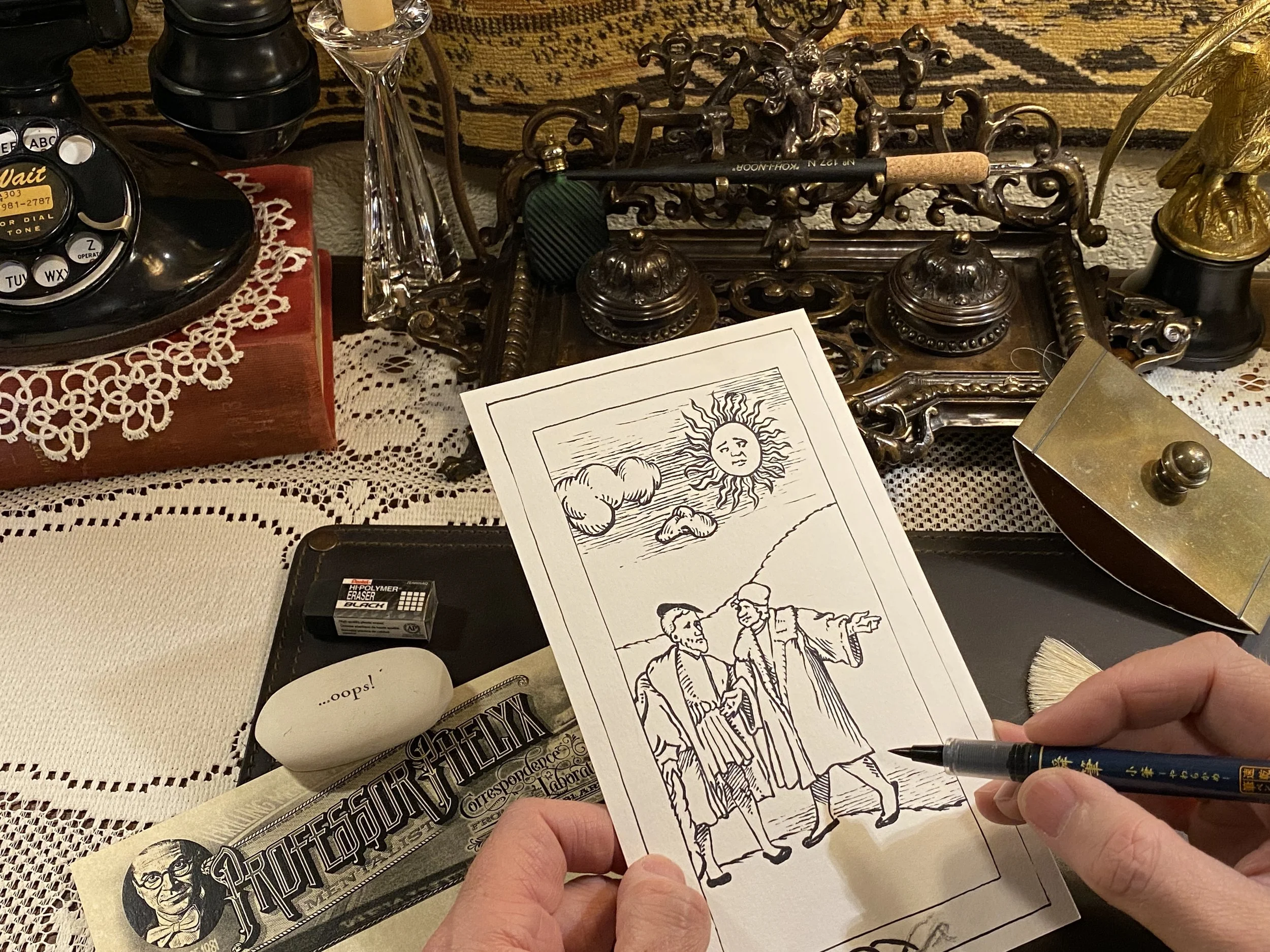
Professor Phelyx’s Tarot: A Slight Retelling of the Deck’s Magical Story
When magician and scholar Professor Phelyx told me he was 500 hours deep in the making of his own tarot deck, I wanted to know why.
My pal Professor Phelyx — emcee, magician, mentalist, artist, aesthete-at-large — has likely popped onto a stage in front of you, especially if you live in Denver. I caught back up with him and learned he’s already 500+ hours in on the creation of his own tarot deck.
I wanted to know why, as almost anything this urbane dude puts his mind to is worth a gander.

He talked to me about why he felt the need to hand-make a woodblock-style tarot mod that nods to his deep-dive into his German lineage and tarot’s historical importance as a storytelling game for everyday folk.
Hit play, learn some cool history, and let The Prof show you his next painstaking trick…